

The most expensive cloud tier is often the cheapest way to run your workload. That sentence sounds wrong until you do the math, and then it sounds obvious, and then you wonder why nobody told you before you spent eighteen months in the wrong place.
Cloud pricing is designed to look like a ladder. Pay more per unit, get more capability. The implicit promise is that you climb as you grow, spending only what your current needs justify. It is a sensible mental model. It is also, for a significant class of workloads, completely backwards.
The tier trap is structural, not accidental
Mid-tier cloud services exist to capture customers who feel guilty about buying the top option and scared of the limitations on the bottom one. That psychological position is extremely profitable for vendors. The customer in the middle is paying premium-adjacent prices while absorbing costs that the top tier would eliminate.
Consider managed databases. On AWS, moving from an RDS instance to Aurora Serverless feels like buying more than you need. The per-unit cost is higher. But Aurora Serverless scales to zero when idle, handles connection pooling natively, and eliminates the class of 3 a.m. incidents where a mid-tier RDS instance runs out of connections under unexpected load. The “cheaper” RDS instance requires an engineer to babysit it. Engineer time is not free. The on-call rotation is not free. The incident retrospective is not free.
This pattern repeats across every major cloud provider. The mid-tier option prices in the hardware cost and prices out the operational intelligence. You get charged like an enterprise and supported like a hobbyist.
Operational overhead is the invoice you never see
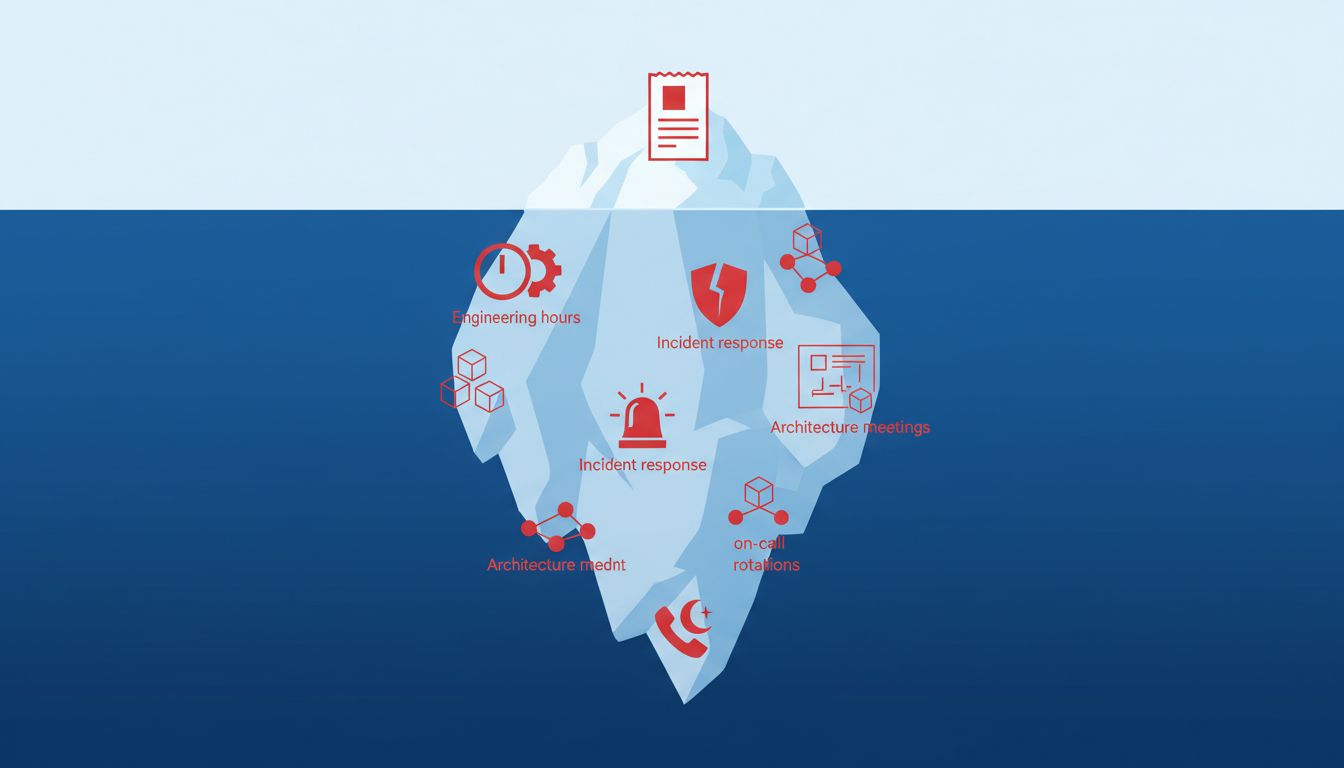
Cloud bills show compute and storage. They do not show the four hours your senior engineer spent tuning auto-scaling parameters on a mid-tier service that a premium service would have tuned automatically. They do not show the cost of the architecture meeting where your team decided to build a caching layer because the mid-tier database couldn’t handle your read volume. The $600K engineer is usually cheaper than the $120K one makes this argument for hiring; the same logic applies to infrastructure.
The free tier at the bottom of the ladder has honest limitations. It tells you what it cannot do. You architect around those constraints from day one, and the constraints are usually sharp enough that you know when you’ve hit them. The mid-tier is treacherous because its limitations are soft. It can almost handle your workload. It handles it until Thursday. It handles it until your marketing campaign lands. The cost of discovering that boundary in production is not on anyone’s pricing page.
Premiums buy predictability, not just performance
The economic case for top-tier cloud services is really a case for predictability. When you pay for managed everything, you are purchasing a known cost surface. The bill is higher and bounded. The mid-tier bill is lower and unbounded once you account for the engineering time it consumes.
Spotify, Airbnb, and most scaled consumer tech companies end up running on configurations that look extravagant to an outside observer. They are not being profligate. They have done the calculation that their engineers’ time is worth more than the delta between pricing tiers, and that operational incidents carry a cost that compounds. The premium tier is expensive the way good tooling is expensive: the price is visible and the savings are distributed across dozens of future decisions that never become crises.
This is also why the math looks different for companies below a certain engineering headcount. If you have two engineers, the operational overhead of a mid-tier service doesn’t get distributed across a team. It lands entirely on the people who can least afford to spend time on infrastructure.
The counterargument
The honest version of the case for mid-tier services is that managed premium offerings introduce their own lock-in and their own failure modes. Aurora Serverless has cold-start latency. The top-tier managed services are often the ones where AWS or Google can raise prices most aggressively, because switching costs are highest. You are not just buying capability; you are buying dependency.
This is a legitimate concern. But it is a concern about vendor risk and architecture strategy, not about the pricing tier itself. The answer to lock-in risk is architecture choices and contract negotiation, not deliberately choosing a less capable service and paying engineers to compensate for its limitations. Choosing the mid-tier to preserve optionality is mostly a rationalization. The optionality you’re preserving costs real money every month.
The bill is the least of your costs
Cloud pricing is legible. Engineering time, incident costs, and architectural debt are not. The mid-tier exploits that asymmetry. It wins the budget meeting because its number is smaller, and it loses the actual cost comparison because that comparison never gets done with full information.
The discipline required here is forcing every infrastructure decision to include an honest accounting of operational overhead. That means estimating engineer-hours, not just compute hours. It means asking not what a service costs at rest, but what it costs when something goes wrong, and how often something will go wrong.
When you do that accounting, the second-cheapest option is usually the most expensive. The most expensive option is often the bargain. The pricing ladder is not lying to you, exactly. It just isn’t telling you the whole story, and the story it’s omitting is the one that matters.