
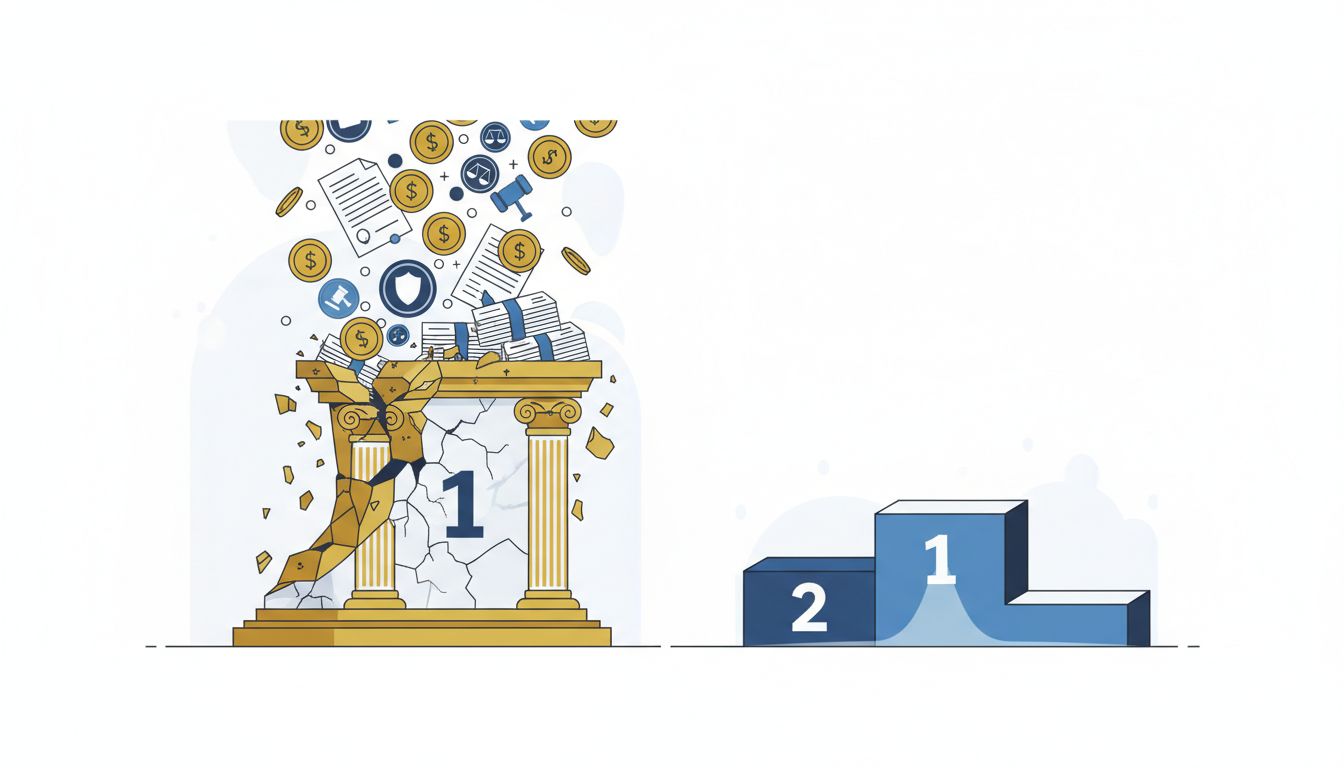
The Trophy Is Expensive
Being first in a tech market is prestigious and frequently unprofitable. The company holding the top position spends heavily to stay there: acquiring potential threats, lobbying regulators, running loss-leader pricing to keep challengers out, and maintaining the engineering headcount to sustain a product suite that must serve everyone. The number-two company does none of this at the same scale. It serves a defined customer base, charges prices the market-maker has effectively set for it, and directs R&D at specific gaps rather than the entire frontier.
This is not a theory. It shows up repeatedly in financial history, acquisition prices, and the way markets actually consolidate. The instinct to call the market leader the most valuable company in its category is usually wrong, and the error is systematic enough to be worth understanding.
Why Market Leadership Costs So Much
Consider what it costs to hold first place. Microsoft spent years and billions on its antitrust defense in the late 1990s. Google has faced competition enforcement actions across the EU and the United States that have consumed executive attention and legal budget while constraining product decisions. Meta has cycled through Federal Trade Commission inquiries, congressional hearings, and ongoing litigation with a frequency that a smaller competitor simply does not face.
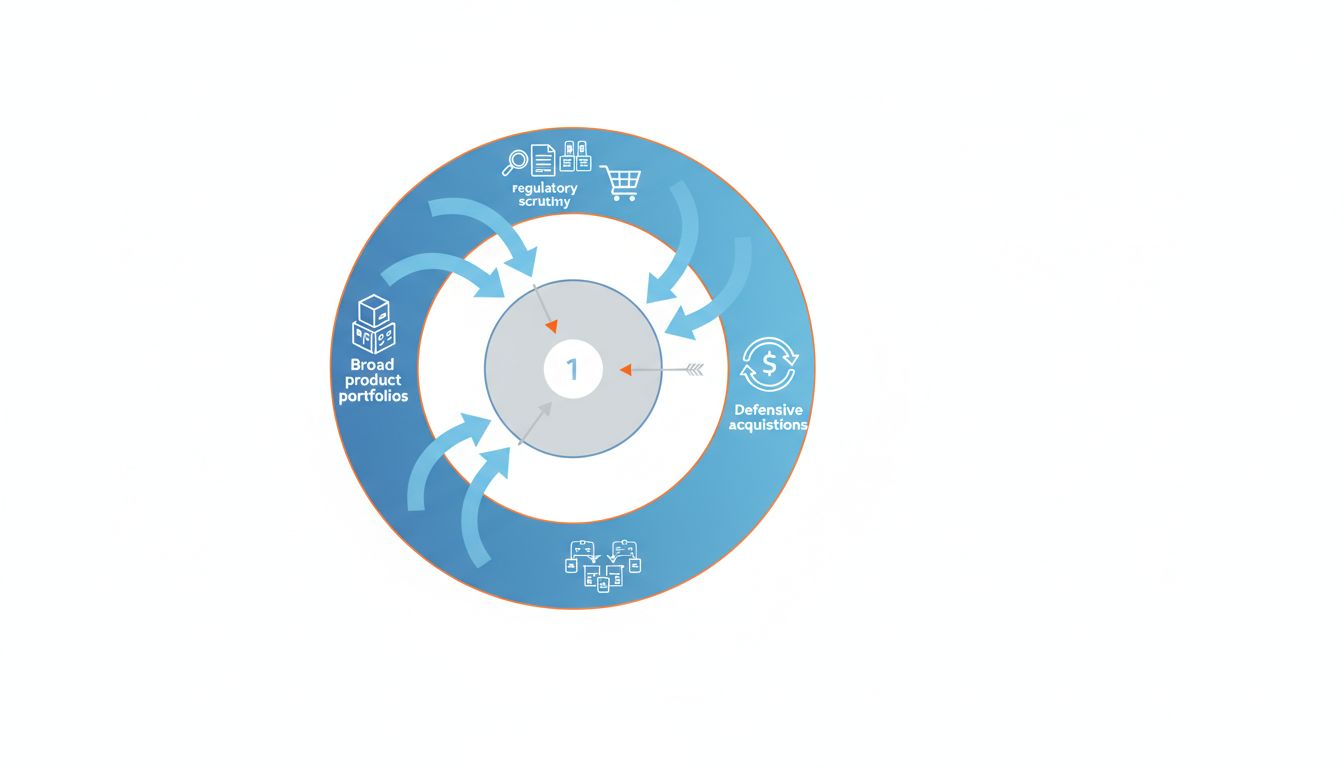
The logic here is straightforward: regulators follow market share. A company with 65% of a market attracts scrutiny that a company with 25% of the same market does not. This asymmetry in regulatory exposure is a genuine cost that rarely appears on income statements in a clean line item but shows up in slower product cycles, restricted acquisition strategies, and compliance overhead.
Then there is the problem of the full product portfolio. The dominant player in any market is expected to serve every customer segment. Salesforce cannot walk away from small business customers even if that segment is unprofitable, because doing so would hand a beachhead to a competitor. The second-place player can be selective. It can optimize for the most profitable customer profiles and let the leader absorb the rest.
The Profitability Gap Is Real
Look at search advertising. Google controls the overwhelming majority of global search revenue. Microsoft’s Bing has a much smaller share. But Bing’s operating margin has historically been strong relative to its revenue base, partly because Microsoft does not have to fund the same scale of infrastructure investment to maintain a leadership position it is not trying to claim. Bing is also insulated from the most aggressive regulatory pressure on search, which lands on Google.
The same pattern appears in cloud computing. Amazon Web Services built the market, set pricing norms, and still holds the largest share. But Microsoft Azure and Google Cloud have entered at a point where the hard infrastructure problems have been partially solved by AWS’s trial and error, where enterprise sales processes are understood, and where customers are already trained to think in terms of cloud spending. The second and third entrants benefit from market development they did not pay for.
In mobile operating systems, Android runs on most of the world’s phones by volume. But Apple, with a smaller share, consistently generates the majority of smartphone industry profits. This is partly a premium pricing story, but it is also a story about not having to be everything to everyone. Android’s openness, which helped it win market share, creates fragmentation costs and security maintenance burdens that iOS avoids by controlling its environment more tightly.
Second Place Is a Better Acquisition Target
Acquisition math also favors the runner-up. When a market leader buys a competitor, it faces immediate regulatory scrutiny. The deal has to clear a higher bar because the acquirer is already dominant. Antitrust review becomes longer, more expensive, and increasingly likely to result in conditions or outright blocks.
The second-place company, by contrast, can be acquired by a large player from an adjacent market that wants to enter the category quickly. It can also be acquired by private equity without attracting the same level of review. And because it is not the market leader, it has not yet commanded the valuation premium that comes with a number-one position, which makes the return math cleaner for acquirers.
This is one reason what you actually own when you buy a software company matters so much to acquirers assessing these deals. The second-place company often has cleaner customer relationships, less technical debt from trying to scale to market-wide dominance, and a more focused product.
The Innovation Argument
There is a common assumption that the market leader innovates fastest because it has the most resources. The evidence is more complicated. Dominant companies tend to optimize their existing revenue streams rather than risk cannibalizing them. This is not a character flaw; it is a rational response to having shareholders and a large installed base to protect.
The second-place company has a different incentive structure. It cannot win by standing still. It has to find the segments where the leader is overpriced, underbuilt, or simply not paying attention. This necessity produces focused innovation rather than broad innovation, and focused innovation tends to produce better products for specific customers.
Netflix did not displace Blockbuster by being a better version of Blockbuster. Spotify did not win by offering more songs than iTunes. In each case, the challenger identified a specific structural weakness in the leader’s model and built around it. Second place is where that kind of targeted thinking happens most productively, because the alternative is irrelevance.
The Catch: Second Place Is Unstable
None of this means second place is comfortable. The position is inherently precarious in a way that first place is not. The market leader has a defensible floor; the runner-up is always at risk of being displaced from below by a third entrant with a newer approach, or from above by the leader deciding to actually compete for the customers it had previously ignored.
The companies that make second place work over long periods of time are those that treat it as a deliberate strategy rather than a temporary condition. They resist the urge to spend like a market leader to become a market leader, which usually ends in the worst outcome: the costs of leadership without the pricing power that justifies them. They stay focused on the customer segments where they genuinely win, and they let the leader maintain the rest.
This is a harder management problem than it looks. The narrative pull toward “winning” the market is strong, and investors often reward aggressive expansion over disciplined margin management. Companies that resist this pull tend to have founders or executives who are genuinely comfortable with a defined position, not ones who see second place as a temporary embarrassment.
What This Means
If you are evaluating tech companies as an investor, analyst, or acquirer, the market share ranking is a starting point, not a conclusion. The questions that matter more are: Who is spending to defend a position versus spending to improve a product? Who is absorbing regulatory friction as a structural cost? Who has the flexibility to serve their best customers well rather than serving every customer adequately?
The answers frequently point to the number-two company. It does not carry the cost of the crown. It competes for defined customers rather than the whole market. It innovates out of necessity rather than as a discretionary activity. And when someone larger decides the category is worth entering, it tends to be the acquisition target rather than the acquirer, which historically is the better side of that transaction to be on.
First place is a more interesting press release. Second place is often the better business.