

There is a predictable moment in many board meetings when someone looks at the engineering headcount budget, notes that senior engineers now cost $350,000 to $450,000 in total compensation at competitive companies, and suggests the number needs to come down. The suggestion sounds reasonable. It is usually wrong.
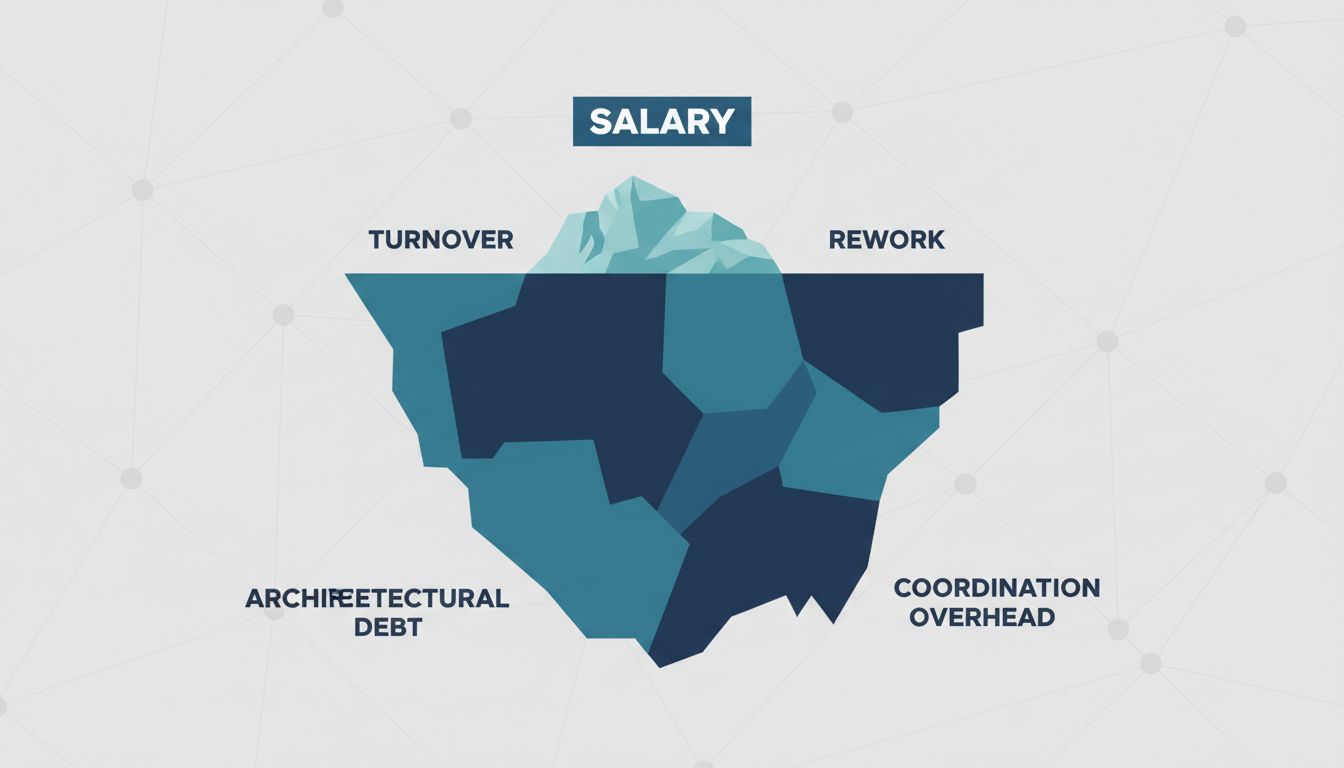
Salary is visible. The costs it prevents are not. That asymmetry explains most bad hiring decisions in tech, in both directions.
1. The Wrong Architecture Costs More Than a Decade of Salaries
One senior engineer making the right call on a system’s foundational design is worth more than any reasonable salary figure. One junior engineer (or one distracted senior engineer, or one absent engineer because the role went unfilled) making the wrong call can produce a codebase that takes years and millions of dollars to escape.
This is not theoretical. Many of the most expensive engineering projects in tech history are rewrites, not greenfield builds. Companies that scaled quickly on expedient early choices often spend their Series C and Series D budgets paying down architectural debt that a differently structured early team might have avoided. The salary of the person who could have prevented the problem rarely appears in the post-mortem.
2. Cheap Engineers Are Often the Most Expensive Coordination Cost
When companies try to reduce engineering costs by hiring more junior people, they frequently underestimate what those hires require to function. Junior engineers need review time from senior engineers. They need clearer specs, more iterations, more management attention. They generate more bugs that reach production and require more debugging cycles.
None of this is a knock on junior engineers, who are necessary and valuable. The accounting error is treating a junior hire as simply a cheaper version of a senior hire. They are a different product entirely, with different inputs required. The blended cost, when you include the senior time consumed in oversight and rework, often exceeds what a senior hire would have cost. The difference is that the senior time shows up on no one’s spreadsheet.
3. The $400K Engineer Often Works on the Thing Nobody Else Can
The best senior engineers are not doing more of what everyone else does. They are doing things that, without them, would either not get done or would get done badly enough to create serious downstream problems. They are the ones who know why deleting a column takes hours in a live database and can architect around that constraint before it becomes a 3am incident.
That expertise is not replaceable by headcount. Four engineers who cannot diagnose an obscure concurrency bug do not collectively become one engineer who can. The market for genuine depth prices accordingly, which is why top-of-band compensation has continued to rise even as the industry has gone through multiple contraction cycles.
4. Turnover Is the Hidden Tax on Underpaying
Engineering turnover is ruinously expensive and almost never fully accounted for. A departing engineer takes institutional knowledge, ongoing context about system behavior, and team velocity with them. Recruiting, onboarding, and returning a new hire to the productivity level of the person who left typically takes six months to a year and costs, by most estimates from recruiting firms and compensation analysts, somewhere between 50 and 200 percent of annual salary.
Undercompensating engineers accelerates turnover. The engineers who leave first when they feel undervalued are, almost by definition, the ones with the most options, which means the ones the team could least afford to lose. What looks like a compensation budget being held flat is often a turnover tax being deferred.
5. Senior Engineers Make Decisions That Cannot Be Undone Cheaply
Architecture is not the only place this applies. Senior engineers make decisions about libraries, about vendor dependencies, about data models, about API contracts. Many of these decisions are cheap in the moment and expensive to reverse. A team that makes those decisions carelessly because the careful people are too expensive to hire will spend years negotiating with its own past choices.
This is part of why context switching doesn’t just slow engineers down: the tax on interrupted senior engineers is not lost time, it is lost judgment applied at the wrong moment, on the wrong problem, with insufficient attention. Spreading senior talent thin to compensate for not hiring enough of it produces the same failure mode as not having it at all.
6. The Comparison Class Is Wrong
When someone objects to a $400,000 engineer, the implicit comparison is usually to other employees at that salary level in other functions. That is the wrong comparison. The right comparison is to the cost of the problem the engineer prevents, or the revenue enabled by the system they build, or the time-to-market advantage they generate.
A senior engineer who can ship a core product feature in three weeks instead of three months, at a company where that feature is the difference between closing an enterprise deal and losing it, is not a $400,000 expense. They are a multiplier on every other dollar the company is spending. Pricing too low kills startups faster than charging too much, and the same logic applies to hiring: the cost of insufficient engineering talent often shows up not as a budget line but as a ceiling on what the company can charge and to whom.
7. Calibration Matters as Much as the Salary Number
None of this is an argument for paying any engineer $400,000. It is an argument for getting the calibration right and being honest about what the alternatives actually cost. Some roles genuinely do not require senior expertise and are well-served by mid-level engineers with good mentorship. Some codebases are simple enough that architectural judgment is not the binding constraint. The mistake is making that determination based on the salary line rather than on what the role actually requires.
The companies that get this right are not the ones that spend the most on engineering. They are the ones that think clearly about where judgment is the scarce resource and pay accordingly for it, while being disciplined about roles where it is not. The companies that get it wrong usually do not realize it until they are rewriting something that should have been built correctly three years earlier.