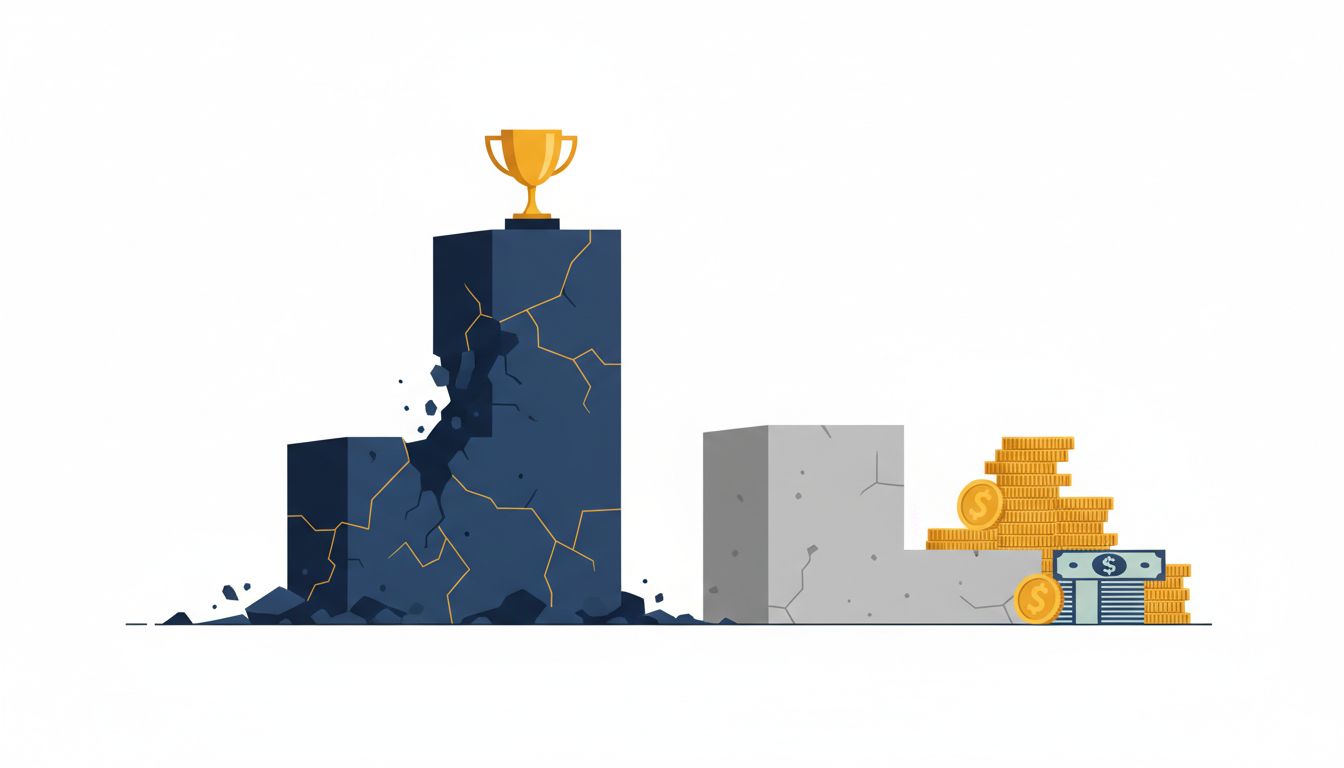

A few years ago, I watched two companies attack the same market. One raised a large seed round, hired aggressively, and moved into a real office with a snack budget that would embarrass a catered wedding. The other raised a fraction of that, kept the team at four people, and charged customers from day one. Eighteen months later, the well-funded company was doing a down round. The lean one had quietly crossed profitability.
This is not a feel-good story about scrappy underdogs. It’s a story about how money, applied too early, destroys the exact conditions that produce good companies.
Scarcity forces the question you keep avoiding
Every early-stage company has a question it should be asking but isn’t: do people actually want this, enough to pay for it? Well-capitalized teams can defer that question for a long time. They can run ads, hire a head of sales, build a beautiful onboarding flow, and convince themselves that traction is just around the corner. The burn rate gives them permission to wait.
Teams without that cushion don’t have the luxury of deferring. They have to find out now. That urgency is uncomfortable, but it’s also the most valuable thing that can happen to a young company. The underfunded team talks to customers out of desperation and accidentally learns what the product should actually be. Build the riskiest thing first, not the easiest, and scarcity has a way of enforcing exactly that.
Small teams make better decisions faster
There’s a coordination tax on every person you add. This isn’t an opinion, it’s arithmetic. Communication paths scale roughly with the square of headcount. A team of four has six communication paths. A team of fifteen has over a hundred.
Well-funded companies hire because they can, and then they spend significant energy managing the people they hired. Stand-ups multiply. Slack channels proliferate. Someone needs to own the roadmap, someone needs to run the roadmap meetings, and someone needs to take notes on the roadmap meetings. The underfunded team, meanwhile, ships.
Basecamp built a product used by millions with a team most funded startups would consider too small to staff a single feature team. Plenty of other examples exist in less-celebrated corners of the software world, companies that chose not to raise more and quietly built something durable.

Revenue-seeking behavior produces a better product
When you need customers to survive, you optimize for customers. When you have a runway measured in years, you optimize for looking like you’re making progress toward customers. These are not the same activity and they produce very different products.
The team charging from day one gets real signal. Customers who pay complain differently than customers who don’t. They tell you what’s actually broken rather than what’s aesthetically displeasing. They churn for real reasons rather than losing interest. That feedback loop is brutal and it’s exactly what shapes a product that works.
Pricing pressure also forces honesty about value. A team that has to charge can’t hide behind “we’ll figure out monetization later.” Charging too little is a strategy, not a mistake, but never charging at all is just denial with a pitch deck attached.
Spending money builds the habit of spending money
Organizational habits form early and stick. A company that spends freely in year one is training every manager, every team lead, and every future hire that spending freely is normal. That culture doesn’t disappear when the money gets tight. It becomes a point of conflict, resentment, and eventually, a very awkward all-hands.
The constrained company builds a different reflex. Before every hire, every tool, every contract, someone asks whether this actually moves the needle. That question becomes muscle memory. When growth comes and more resources are available, the habit of scrutiny persists. You get the benefits of scale without losing the discipline that got you there.
The counterargument
Some markets genuinely require capital to compete. Infrastructure plays, hardware, anything with regulatory moats or long sales cycles — these have structural reasons why underfunding is fatal rather than fortifying. If your go-to-market requires a large enterprise sales team and eighteen-month procurement cycles, telling you to stay lean is just advice that doesn’t apply.
There’s also survivorship bias here. For every lean company that made it, there are underfunded teams that failed not because of discipline problems but because they simply couldn’t build fast enough to win the market before someone better-resourced did. Capital allocation is a real competitive advantage in the right context.
But the VC-funded model has been applied so broadly, to so many businesses that don’t fit its assumptions, that the survivorship bias runs the other direction too. We hear about the well-funded success stories. We rarely hear about the companies that raised too much, scaled too fast, and quietly dissolved after a failed acqui-hire.
The point isn’t to raise less. It’s to spend like you did.
The underfunded startups that win aren’t winning because poverty is virtuous. They’re winning because their constraints forced behaviors that well-funded teams have to consciously choose. The question discipline, the small team dynamics, the revenue focus, the spending scrutiny — none of these are actually dependent on having a small bank account. They’re dependent on having the right priorities.
Some well-capitalized teams figure this out and behave accordingly. Most don’t, because the money makes it too easy not to. That’s the real story here: money doesn’t kill companies directly. It kills them by making hard questions optional.