
In 2012, a founder I know built a solid SaaS product for independent insurance brokers. It worked. Customers loved it. Renewal rates were strong. By 2016, he had roughly 40% of the addressable market in that niche and was still adding features for the same buyers. By 2019, he was fighting to hold 25% of a market that had started consolidating around two large carriers with their own captive software. He hadn’t made a bad product decision. He had made a bad strategic one: he confused market penetration with business momentum.
This is the trap. You find product-market fit, which is genuinely hard, and the relief of that discovery warps your sense of what comes next. You double down on the market that validated you. You hire for it, price for it, build your roadmap around it. And while you’re doing that, the market itself is moving, consolidating, commoditizing, or simply getting less interesting to the customers who matter.
Saturation Looks Like Success Until It Doesn’t
The dangerous period isn’t when things are going badly. It’s when they’re going suspiciously well. Revenue is predictable. Your sales team knows the buyer persona cold. Your NPS is strong. This is when most founders stop asking the hard question: is this market still worth owning?
Market saturation rarely announces itself. What you see first is that your sales cycles get longer. Customers who used to take four calls now take eight. Win rates hold steady but deal sizes stop growing. Your customer success team starts spending more time defending renewals than expanding accounts. None of these individually triggers alarm. Together, they’re the early signature of a market that has absorbed what you built and is no longer hungry for it.
The instinct is to interpret these signals as execution problems. Sales needs better training. Marketing needs tighter messaging. The product needs more features. Sometimes that’s true. But often it’s a strategic problem wearing an operational costume, and no amount of execution improvement fixes a market that has run out of room.
The Pivot Isn’t the Problem. The Timing Is.
Startups that expand too early die differently but just as surely. They abandon the market before they’ve extracted enough value to fund the next move. The right question isn’t whether to expand, it’s when the business has the revenue base, the team, and the learnings to make expansion survivable.
The companies that get this right typically share one pattern: they use their first market as a laboratory, not just a revenue source. Every assumption they test with early customers, every integration they build, every sales objection they learn to handle becomes transferable knowledge. Shopify started with snowboard shops. Amazon started with books. Neither stayed there because both understood that the real asset wasn’t the first market, it was the operational and technical infrastructure the first market let them build.
That infrastructure is what makes adjacent expansion possible without starting from scratch. A founder who spent three years selling to independent insurance brokers learned a lot about document workflows, compliance anxiety, and the specific ways small businesses tolerate software friction. Those learnings translate. The mistake is not moving them anywhere.
Adjacency Is a Strategy, Not a Random Bet
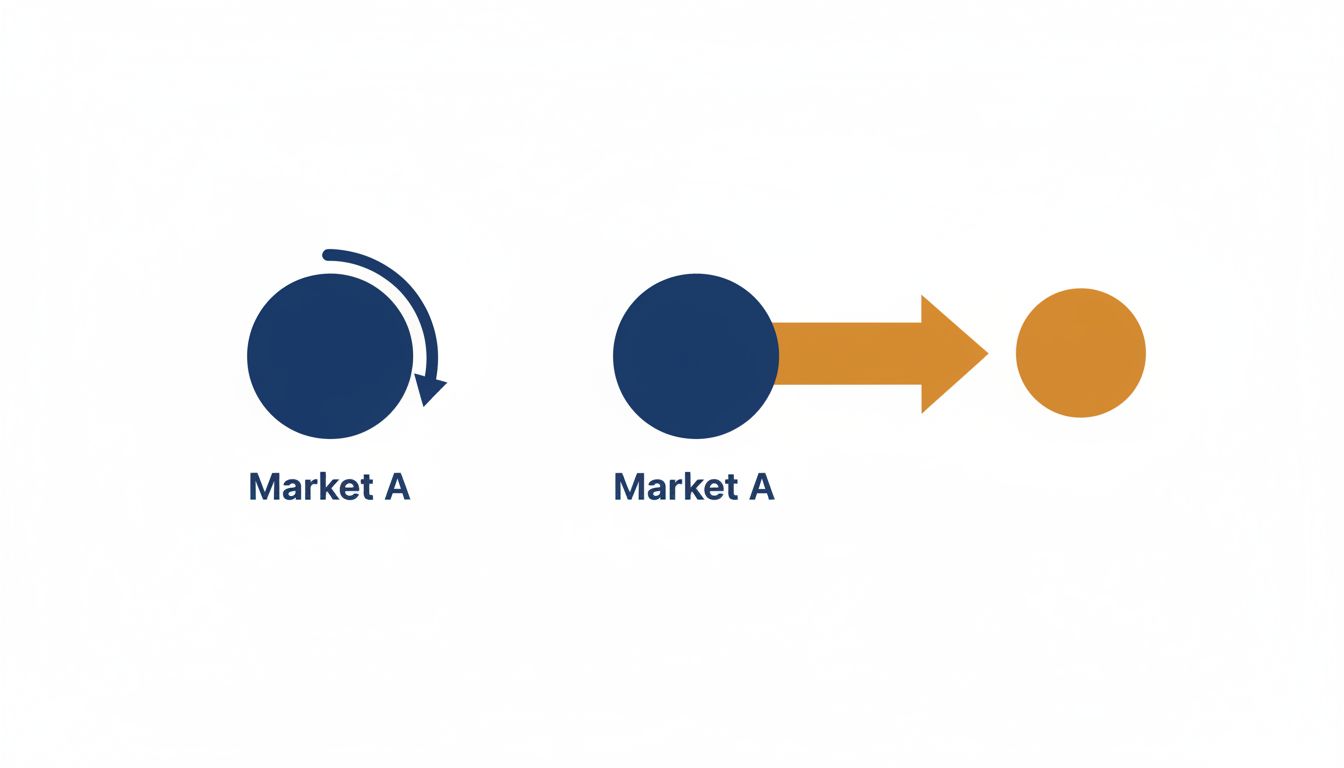
Expansion fails when it’s treated as a reset rather than an extension. The companies that thrash into new markets cold, with a new buyer persona and a new use case and a new competitive set, are essentially doing two startups at once. That almost never works with a single team.
Adjacent expansion means finding the market where your existing advantages transfer with minimal reinvestment. Your distribution model still applies. Your product requires real but manageable changes. The buyer has the same pain, even if the industry label is different. Veeva started in pharma CRM and expanded into other regulated life sciences verticals. They didn’t jump to retail. They stayed in the lane where compliance complexity was the moat, and moved along that lane.
The test I’d apply is simple: can you name three specific things from your current market that give you a structural advantage in the new one? If the answer requires creativity to arrive at, it’s probably not a real adjacency. It’s a market you find interesting, which is not the same thing.
What the Data Actually Tells You About When to Move
You don’t need a sophisticated analysis to identify the signal. You need honest answers to a small set of questions. What percentage of your target accounts in the current market are already customers? If it’s above 30 to 40 percent of a well-defined segment, you’re in late-stage penetration territory and the growth math is starting to work against you. What’s the average revenue per account doing year over year? Flat or declining expansion revenue is more telling than headline growth. What’s the competitive intensity doing? New entrants with better unit economics are a sign the market has become attractive to well-funded players, which means your margins are about to get compressed.
None of these requires a McKinsey engagement. They require the kind of honest internal accounting that founders avoid because it forces a conversation about whether the comfortable thing and the right thing are different. Why the Second Company Into a Market Usually Wins has a lot to do with this dynamic. The second mover often benefits from a market the first mover educated and then got complacent in.
The Founders Who Survive This Are Honest About It Earlier
The founder I mentioned at the start eventually sold the company at a price that was fine but not what it could have been. In the post-mortem he was generous enough to share with me, his read was clear: he had enough signal in 2015 to know the market was ceiling-bound, and he kept building features instead of building a second act. Not because he didn’t see it, but because the first market was still good enough that expansion felt like a risk rather than a necessity.
That’s the psychology that kills otherwise solid companies. Good enough becomes the enemy of what comes next. The market that made you starts to feel like an identity rather than a phase. And by the time the numbers make the case undeniably, the window for a graceful expansion has usually closed.
The startup that stays in one market too long doesn’t usually implode. It compresses. Revenue flattens, talent leaves for more interesting problems, the product stops generating conviction internally or externally. It becomes a lifestyle business at a startup’s cost structure, which is the worst of both worlds. The ones that avoid this end are the ones that treat their first market as proof of concept and start asking the next question before the current one stops being fun to answer.