
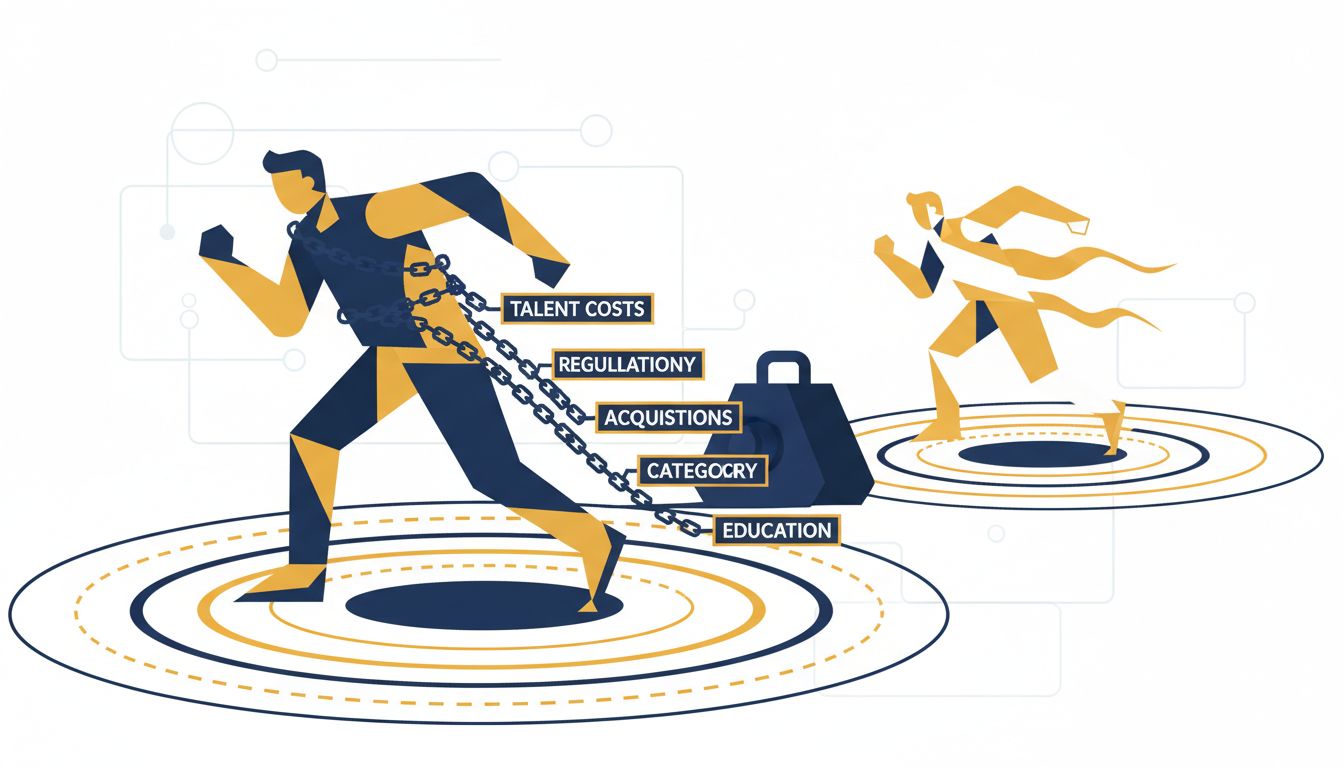
In 2007, AMD was losing the processor war to Intel so badly that analysts were writing its obituary. Then something strange happened: AMD stopped trying to win and started trying to survive profitably. It shed fabs, licensed designs, and focused on niches where it could charge real margins. By the early 2020s, AMD’s stock had outperformed Intel’s by a factor that would have seemed like fiction to anyone watching in 2007. AMD never took the top spot in total market share. It didn’t need to.
This pattern shows up constantly in tech. The company obsessed with winning the market share race often ends up poorer for it. The company in second place, freed from the obligation to dominate, gets to be selective. Here is why that dynamic is almost structural.
1. The Winner Has to Defend Everything
When you own 60 or 70 percent of a market, you have to maintain presence everywhere. Every segment, every geography, every edge case customer, every enterprise procurement process. You can’t walk away from a deal because it’s low-margin, because losing it looks like retreat. Customers know this and use it. Procurement teams at large companies have learned that the market leader will discount heavily rather than lose a flagship account.
The second-place player can walk. They can tell a customer the price is the price, because their brand doesn’t depend on universal coverage. That posture, over thousands of deals, adds up to meaningfully better margins. It’s not a coincidence that Salesforce, for years the clear CRM market leader, has faced more aggressive discounting pressure than competitors with smaller installed bases. Dominance creates hostage-taking.
2. Market Leaders Subsidize the Category, Not Just Their Own Growth
Somebody has to convince skeptical enterprise buyers that a new software category is real. Somebody has to fund the analyst relations, the category-defining conference, the white papers that get distributed at procurement committees. That somebody is almost always the market leader, because the category’s legitimacy is tied to their brand.
The second-place player gets most of the benefit of that education spend for free. By the time a buyer is seriously evaluating a second vendor, the category sell has already happened. They’re comparing features and price. That’s a much cheaper conversation to have. Salesforce spent years and enormous resources convincing enterprises that cloud CRM wasn’t a security disaster. Every competitor that came after them stepped into a pre-warmed room.
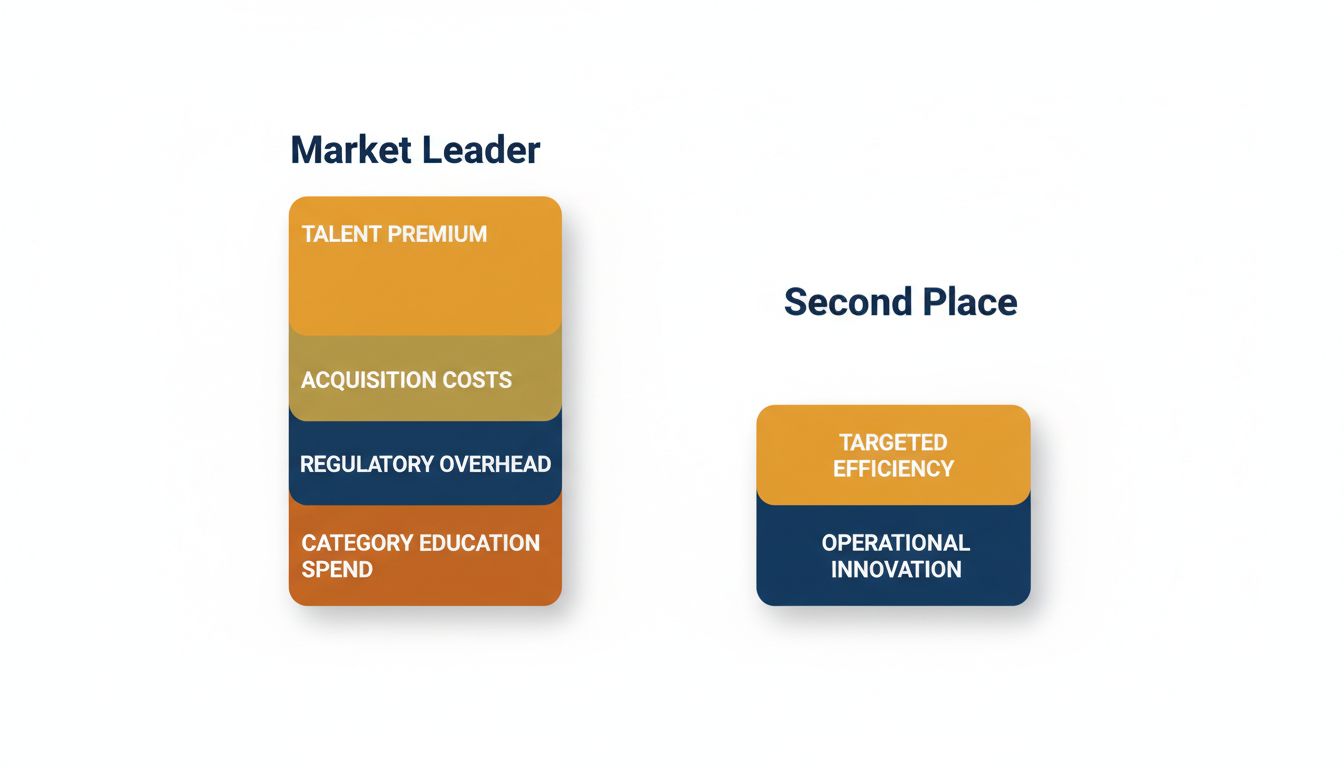
3. Talent and Operational Costs Run Higher at the Top
The best engineers want to work at the company that’s winning. That’s not cynicism, it’s rational career calculus. Which means the market leader pays a talent premium that is real and compounding. They have to offer the best compensation, the flashiest offices, the most aggressive equity refreshes, because prestige demands it and competitors are always recruiting.
Second-place companies have learned to compete on different axes: more interesting technical problems (you’re always the underdog building clever things), more ownership, faster career progression. But the compensation baseline is lower. When you run the math across hundreds of engineers, that difference in average compensation is a substantial line item. It also shows up in real estate, in the size of marketing teams, in the complexity of internal tooling built to support headcount that grew too fast.
4. Second Place Gets to Copy Without Shame
There is an enormous amount of expensive trial and error that goes into being first. The market leader builds features that don’t land, acquires companies that don’t integrate, runs experiments that teach them what customers don’t want. All of that costs money.
The second-place player watches, waits, and copies what works. This sounds unsporting but it’s actually just rational product development. Microsoft watched Slack for years before building Teams. Teams is now larger than Slack by most measures, and Microsoft didn’t pay for the years of product iteration that taught the market what a workplace chat tool should do. The second mover advantage is real, and it compounds most obviously in the company that’s close enough to be taken seriously but not so dominant it has to invent the category’s future.
5. The Winner Has to Acquire, Not Just Build
When you’re the clear market leader, every adjacent startup is a threat that needs to be neutralized. Which means you end up buying companies at prices that are inflated by the very fact that you’re the obvious acquirer. Everyone knows you can’t let the thing fall to a competitor, so everyone prices accordingly.
This is a structural tax on market leadership. Google has paid this tax repeatedly. The second-place player can be selective: acquire what’s genuinely accretive and pass on the rest, because losing a startup to the market leader isn’t existential for them. Salesforce’s acquisition history versus HubSpot’s is an instructive comparison. One has spent billions on acquisitions that have been difficult to integrate; the other has grown more organically and carried much cleaner financials for it.
6. Scrutiny Scales With Market Share
Regulators, press, enterprise customers, and the public pay much closer attention to the dominant player. Antitrust investigations, congressional hearings, newspaper front pages. These are not free. Legal teams swell. Compliance costs compound. PR becomes a defensive operation. The company spends real money managing the optics of dominance rather than building product.
The second-place player operates under a different assumption: they can move faster, take more product risk, make acquisitions without the same scrutiny, and generally behave like a company that hasn’t been declared a monopoly. AMD never had to worry that releasing a competitive CPU would trigger an antitrust investigation. Intel did. That asymmetry had a cost, and Intel paid it in engineering attention diverted to legal strategy.
None of this means it’s better to lose. A market leader with genuine network effects and locked-in customers can be enormously profitable despite all these pressures. But in most tech markets, the correlation between market share rank and profitability is weaker than the headlines suggest. The company that wins the press release rarely wins the income statement. The one running in second, quietly choosing its fights, often does.