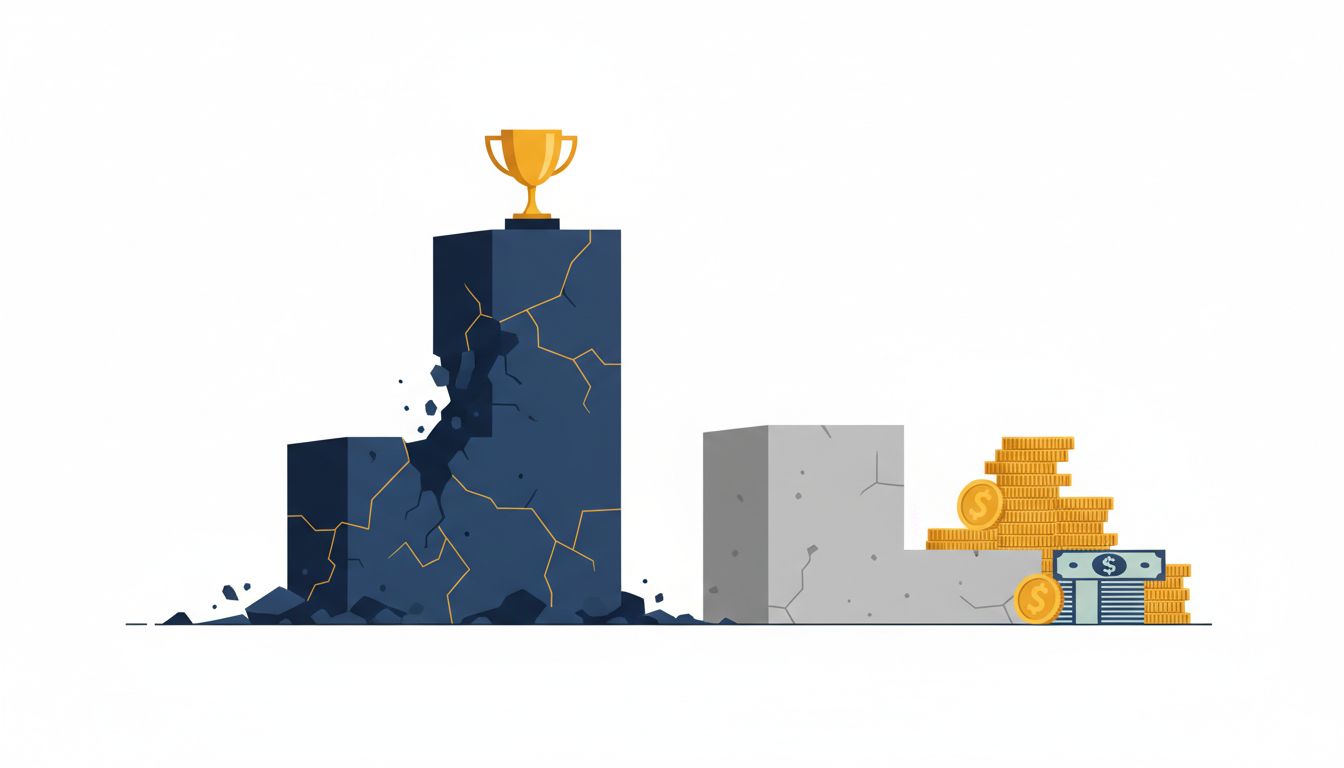

The first-mover advantage is one of the most durable myths in tech economics. Founders invoke it to justify speed over quality, investors use it to pressure premature scaling, and journalists repeat it as received wisdom. The actual record tells a different story.
Amazon was not the first online bookstore. Google was not the first search engine. Facebook was not the first social network. The iPhone was not the first smartphone. In each case, a second (or third, or fourth) mover studied what the pioneer got wrong, fixed it, and walked away with the category. The reasons this keeps happening are structural, not accidental.
1. Pioneers Pay the Market Education Tax
The first company into a market has to convince customers that the category is worth caring about at all. That’s expensive. Webvan spent lavishly building out grocery delivery infrastructure and educating consumers about ordering food online, then collapsed in 2001 before the model was viable. Instacart arrived over a decade later, inherited an already-educated customer base and smartphone penetration Webvan could never have imagined, and made the economics work.
Second movers get this education for free. By the time they arrive, someone else has already absorbed the cost of telling the market what the product is and why it matters. The pioneer does the work; the follower collects the benefit.
2. The First Version Is Always Wrong
Every product launched into a genuinely new market is a hypothesis about what customers want. Those hypotheses are almost always partially wrong in ways you can’t discover without building the thing and shipping it. The pioneer ships the wrong version, learns from it, and iterates. But by the time they’ve learned, the second mover has been watching, absorbing the same lessons without paying for them.
MySpace built a social network. It learned, the hard way, that users wanted clean profile pages, privacy controls, and a way to find people they actually knew rather than strangers. Facebook didn’t have to run those experiments. The results were already public.
This is the underappreciated value of being late. You get a competitor’s entire product development history as a free case study.

3. Early Infrastructure Is Usually the Wrong Infrastructure
Pioneers build on whatever technology exists when they start. That technology is frequently not the right foundation for the mature version of the product. The second mover builds on better infrastructure, often with dramatically lower costs.
Netscape built the commercial web browser business and owned it completely. Then Internet Explorer arrived, built on Microsoft’s existing distribution and OS integration, and within a few years held over 90 percent market share. The infrastructure available to the second mover, in this case Windows and OEM deals that put IE on every new PC, was categorically better than what existed when Netscape launched.
The same pattern played out in cloud computing. Many companies built private data centers before AWS existed. AWS arrived later, built on commoditized hardware and open-source software that matured in the interim, and undercut everyone’s cost structure while offering better reliability. The pioneer’s infrastructure investment became a liability.
4. Second Movers Inherit a Ready Talent Pool
Building something genuinely new requires convincing engineers, designers, and operators to take a risk on an unproven category. The pioneer attracts the adventurous early adopters among the talent pool, but also accepts people who couldn’t get jobs elsewhere. The second mover recruits from the pioneer’s alumni network, full of people who know the domain deeply and are eager to apply hard-won lessons somewhere with better odds.
Google hiring away engineers from earlier search companies, and Facebook recruiting from Friendster and MySpace, weren’t accidents. They were the second-mover talent dividend playing out in real time.
5. The First Mover Often Can’t Abandon Its Own Decisions
Once a company acquires real customers, changing the product becomes politically and technically expensive. The pioneer is locked into early architectural decisions, pricing models, and customer expectations that made sense at launch but don’t make sense for the mature market. The second mover has no such constraints. It can design for the world as it is, not the world as it was when the category was invented.
This is the same reason incumbents consistently lose to new entrants even when they see the threat clearly. (Clayton Christensen made the argument about disruptive innovation, but the underlying mechanism is simpler: the cost of change scales with the size of what you’ve already built.) The pioneer’s success becomes the source of its rigidity. As one related pattern shows, premature scaling kills more startups than bad ideas, and early scaling locks in exactly the decisions that will be hardest to undo.
6. Timing Multipliers Are Real
Some markets only become viable after external conditions mature. Broadband penetration, smartphone adoption, cloud infrastructure, payments APIs, cheap GPS chips: each of these enabled categories that technically existed before, but couldn’t work at scale. The pioneer who arrived before the enabling infrastructure existed wasn’t wrong about the destination, just the timing.
General Magic built a handheld connected device in 1994 with an ambitious app ecosystem and a vision that reads like an iPhone pitch deck. It failed, not because the idea was bad, but because the mobile internet didn’t exist yet. Apple launched the iPhone in 2007, when 3G networks, capacitive touchscreens, and mobile app distribution had all matured enough to make the product viable. Steve Jobs was not a better visionary than the people at General Magic. He had better timing.
7. The Winner Is Usually the Second Mover With First-Mover Energy
None of this argues for lethargy. The second movers who actually win don’t wait passively while pioneers make mistakes. They move fast once the market is proven, apply aggressive capital allocation, and treat the pioneer’s entire product history as a gift. The failure mode for second movers is waiting too long, or failing to differentiate meaningfully from what the pioneer built.
The winning formula is patience on category timing, urgency on execution. Wait until the market is real and the mistakes are visible. Then move as if you were first.
The mythology around first-mover advantage persists because it makes a better story. The scrappy startup that invented a category and won is more compelling than the shrewd operator who watched carefully, learned everything, and then executed. But markets don’t reward narrative. They reward whoever solves the customer’s problem best, at the right price, at the moment the customer is ready to pay. Arriving second, with better information, is often the cleaner path to that outcome.