

Most remote teams discover async communication the same way: a few too many pointless standups, a timezone conflict that kills a Friday afternoon, and someone forwarding a Basecamp or Notion article about “working async.” The conclusion they reach is usually “have fewer meetings.” That conclusion is not wrong, exactly. It’s just about 20% of the idea.
Async-first communication is a design principle for how information moves through an organization. Treating it as a scheduling preference misses the structural changes it demands. Here’s what those actually look like.
1. Async-First Is a Writing Discipline, Not a Calendar Preference
The biggest misconception is that going async just means defaulting to Slack or email instead of Zoom. The medium is not the point. A Slack channel full of vague, context-free messages that require three clarifying replies is not async communication. It’s synchronous communication with artificial delay.
Real async communication means writing messages that don’t require a reply to make sense. The mental model that helps here is to think of your message as a function call with explicit parameters rather than an opening line in a conversation. Instead of “Hey, can we talk about the auth refactor?” you write: what you’re proposing, what decision you need, what the deadline is, and what happens if no one responds. That’s a complete unit of communication. A good heuristic is the “no-reply-needed” test: can the recipient act on this without asking you anything?
This is genuinely harder than scheduling a meeting. It forces you to do the thinking upfront instead of distributing it across a conversation. That’s the point.
2. Response Time Expectations Are Infrastructure, Not Etiquette
Every team has implicit norms about how fast you’re supposed to respond to messages. In most teams, those norms are never written down, which means they’re set by whoever sends the most anxious follow-ups. The result is a culture where “async” tools (Slack, email) are used with synchronous urgency, and people end up glued to notifications all day to avoid seeming unresponsive.
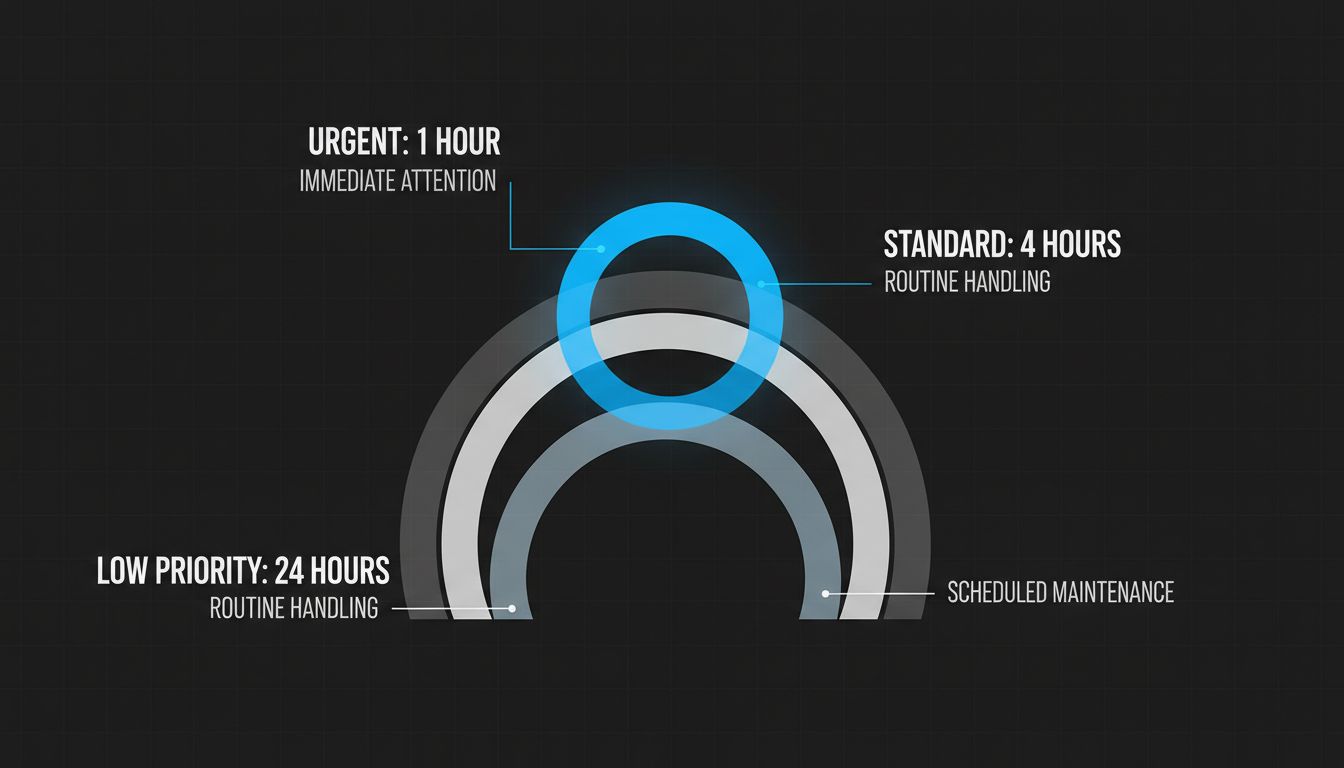
Async-first requires making response time expectations explicit and tiered. Something like: Slack messages get a response within 4 hours during your working day. Emails get a response within 24 hours. A message marked urgent (with a defined standard for what urgent means) gets a response within 1 hour. These aren’t arbitrary numbers. They’re a contract between teammates that makes it safe to close Slack for two hours and actually think.
Without this, you haven’t gone async. You’ve just made everyone feel guilty about not being perpetually available.
3. Decisions Need a Record, Not Just a Chat
One of the most damaging patterns in remote teams is the decision that lives only in a Slack thread. Someone asks a question, a few people weigh in, a direction is chosen, and then it’s buried under three weeks of other messages. Six months later, a new hire makes the opposite decision because they have no idea the first one was ever made.
Async-first organizations treat decision documentation as part of the decision itself. The pattern that works is something close to an architecture decision record (ADR): a short document that captures what was decided, what the alternatives were, and why this option won. It doesn’t have to be formal. A Notion page with three bullet points beats nothing. The discipline is routing the final decision to a searchable, durable location, not just resolving it in chat.
This also makes async decision-making faster, which surprises people. When you know a decision will be documented and findable, you stop re-litigating settled questions. The overhead of writing it down is offset almost immediately by the reduction in repeated discussions.
4. Not Everything Should Be Async, and Pretending Otherwise Makes Teams Worse
Async-first does not mean async-always. This is where a lot of teams overcorrect and make themselves miserable. There’s a class of conversation that is genuinely better handled synchronously: emotionally loaded feedback, high-uncertainty creative exploration, and anything that requires rapid back-and-forth to reach a shared mental model.
Trying to deliver difficult performance feedback over a written document is not being async-first. It’s being conflict-averse with extra steps. A 30-minute video call can settle an architectural debate that would take three days of threads with mounting frustration. The discipline isn’t eliminating synchronous communication; it’s being deliberate about when it’s actually the right tool. A useful diagnostic: if the conversation requires more than three exchanges to resolve, schedule the call. If it can be resolved in one well-written message, write it.
The teams that get this right end up having fewer but better synchronous interactions. The meeting you do have actually does more work because the surrounding communication is already high-quality and documented.
5. Async-First Requires Psychological Safety Around Latency
Here’s the thing that nobody talks about in the blog posts about remote work best practices: async communication only works if team members aren’t punished for response latency. If a manager consistently pings someone and then visibly escalates when they don’t get an immediate reply, no amount of “we’re an async team” culture documentation matters. The behavior at the management level defines the actual norms.
This is fundamentally a trust problem. Synchronous communication is, in part, a trust signal. Seeing someone on a call, watching them respond in real time, provides managers with a sense of presence that substitutes for trust. Async communication requires replacing that with outcome-based trust: you trust that people will deliver what they committed to, within the agreed timeframe, without constant check-ins as proof of work.
Teams that implement async tooling without building this kind of trust end up with a worst-of-both-worlds situation: they have all the coordination overhead of async written communication plus the surveillance anxiety of synchronous culture. That’s not a productivity system. That’s just a bad job with a Notion workspace.
6. Timezone Overlap Is a Feature to Be Designed, Not Eliminated
The async-first movement emerged partly from distributed teams working across timezones, and some teams took the lesson to mean that timezone overlap is an inefficiency to engineer away. Hire globally, work whenever, communicate only in writing. In practice, fully distributed teams with zero intentional overlap often develop serious collaboration problems around anything ambiguous or exploratory.
A more useful design principle is minimum viable overlap: identify what genuinely requires real-time coordination and schedule just enough shared hours to cover it. Many high-performing distributed teams settle on two to four hours of daily overlap between any two collaborating teammates, not because they need to fill that time with meetings, but because it creates a window where a quick synchronous conversation is possible if the async thread is going off the rails.
The goal is optionality. You want to be able to go async on routine coordination and synchronous on the things that actually benefit from it. Removing the option of synchronous communication in the name of async-first is trading one dogma for another.