The simple version
Starting a project gives you a hit of motivation that the middle and end simply don’t provide. Your planning process is probably making this worse without you realizing it.
Why the beginning feels so good
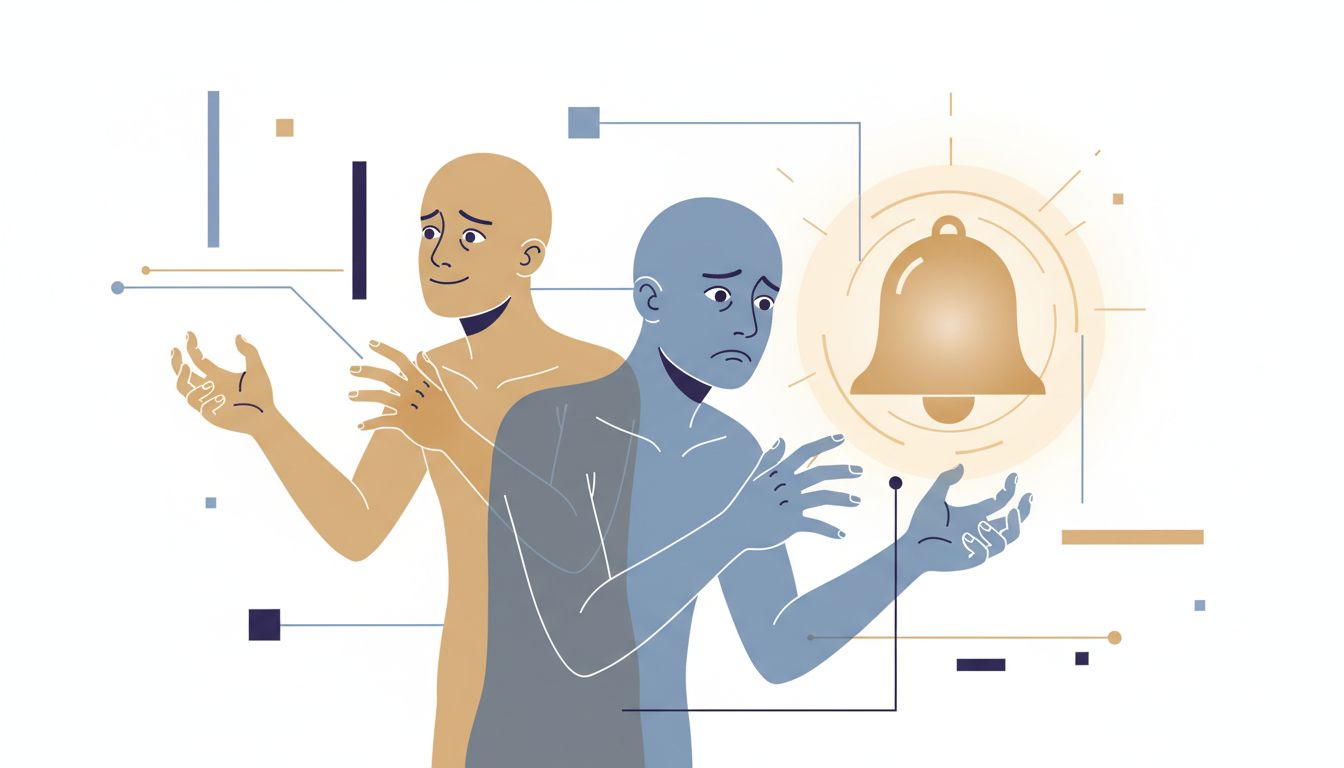
When you decide to start something, you’re working almost entirely in imagination. The project exists as a clean idea, free of complications, edge cases, and the particular tedium of whatever step 7 turns out to be. Psychologists call this “construal level theory”: the further away something is (in time, space, or abstraction), the more your brain represents it in high-level, positive terms. Close things get messy. Distant things stay beautiful.
This is why a new project on Monday morning feels genuinely exciting, and that same project on Thursday afternoon feels like a slog. Nothing went wrong. You just got closer to it.
There’s also a neurological dimension. Planning something activates the brain’s reward circuitry in ways that are surprisingly similar to actually completing it. In a real sense, your brain has already started cashing in the reward before you’ve done any of the work. By the time you’re halfway through, the dopamine hit is spent, and all you have left is the actual effort.
The planning trap hiding inside your to-do list
Most people structure their tasks around starting, not finishing. You write “start report,” “begin research,” “set up project folder.” These are starting-shaped tasks. They feel completable because the scope is fuzzy enough that you can declare victory early.
The problem is that starting tasks don’t map to finished work. You can check off “begin research” after 20 minutes and technically be correct. The task is done. The work isn’t.
When researchers study task completion rates, one pattern holds consistently: tasks with clear endpoints get finished at higher rates than tasks with clear starting points. “Write the introduction” finishes more often than “start writing.” The finish line has to be visible from the start for you to run toward it.
This connects directly to how high-performing teams define completion differently than most. If you’ve ever worked somewhere with a rigorous definition of done, you’ll recognize that the specificity isn’t bureaucratic overhead. It’s what makes finishing a concrete, reachable thing instead of a vague aspiration.

The middle is where projects actually die
Most project failures don’t happen at the start or the end. They happen in what researchers on goal pursuit call “the stuck middle,” roughly the 40-70% completion zone. You’re past the excitement of beginning, but not close enough to the end to feel the pull of near-completion.
This is where motivation research gets practically useful. Teresa Amabile’s work at Harvard Business School, documented in her book “The Progress Principle,” found that the single biggest motivator for people doing complex work isn’t recognition, autonomy, or even compensation. It’s the perception of making progress. Small wins, visibly registered, produce more sustained effort than almost anything else.
The implication is uncomfortable: if your planning doesn’t create regular, visible markers of progress through the middle of a project, you’re flying on nothing but willpower during the hardest stretch. And willpower is genuinely finite, regardless of how much productivity content suggests otherwise.
What this actually tells you about how to plan
Three adjustments that cost almost nothing to implement:
Write tasks as finished states, not starting actions. Instead of “work on the proposal,” write “proposal introduction complete” or “three competitor examples gathered.” You’re forcing yourself to define what done looks like before you start. This is harder than it sounds, and the difficulty is the point. If you can’t describe the finished state, you don’t actually know what you’re trying to accomplish yet.
Build explicit middle checkpoints. For any project longer than a day or two, map out at least two or three moments where you’ll have something concrete to show for your effort, even if only to yourself. These aren’t just morale boosts. They’re navigational markers that let you tell whether you’re on track. Without them, you can’t distinguish between “this is hard because it’s hard” and “this is hard because I’m going in the wrong direction.”
Audit your to-do list for completion asymmetry. Look at your current task list and count how many items have a clear endpoint versus how many are just activities. “Research competitors” is an activity. “List five competitors with their pricing” is a task. If most of your list is activities, your list is tracking effort instead of outcomes. Your list may already be sorted around the wrong dimension for similar reasons.
The honest part
None of this solves the fact that some work is genuinely unpleasant in the middle. Writing a difficult section, debugging a system that won’t cooperate, having a hard conversation with a client. Better planning won’t make those feel good.
What it does is remove the extra layer of friction that bad planning adds on top of necessary difficulty. When you can’t see the finish line and you have no intermediate markers and your tasks are all starting-shaped, you’re fighting the work and the structure simultaneously. Good planning clears the structure out of the way so you’re only fighting the work.
That’s actually achievable. Starting is easy because everything about it is set up to feel that way. Finishing just needs a little of that same intentional setup.