
Retrieval-Augmented Generation has become the go-to answer whenever someone complains that their LLM doesn’t know about recent events, internal documents, or company-specific data. The logic seems airtight: the model’s knowledge is frozen at training time, so you fetch the relevant information at query time and hand it to the model along with the question. Fresh context, better answers. Problem solved.
Except the problem you’re solving and the problem you think you’re solving are often two different things.
RAG is a real and genuinely useful technique. But it’s worth understanding exactly what it does before you invest weeks of engineering time into a pipeline that may disappoint you.
What RAG Actually Does, Step by Step
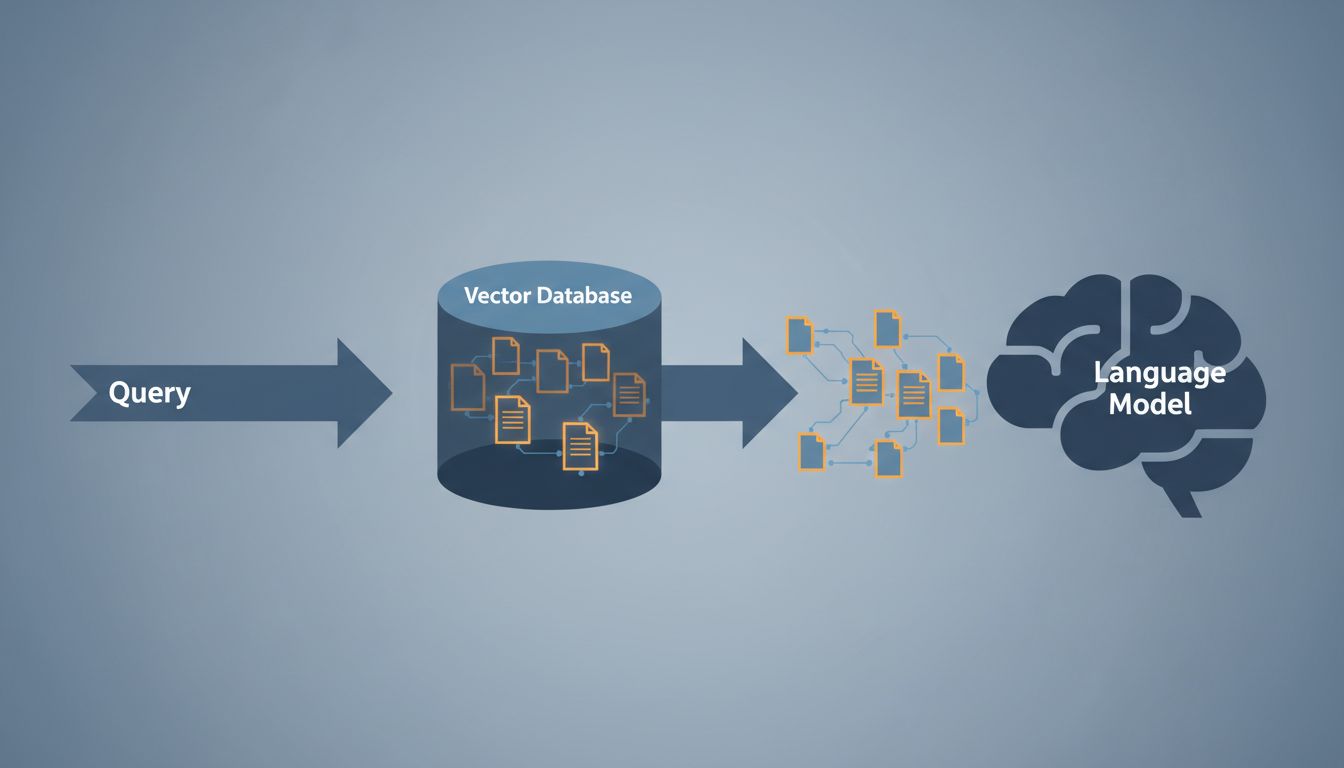
The mechanics are straightforward once you see them clearly. When a user asks a question, your system converts that question into a vector embedding, a numerical representation of its meaning. It then searches a database of pre-embedded documents for chunks whose embeddings are similar. Those chunks get stuffed into the prompt alongside the original question, and the model generates an answer drawing on both its training and the retrieved text.
That’s it. There’s no magic here, just a fast similarity search followed by in-context learning. The model isn’t being updated or retrained. It’s reading documents the same way it would if you pasted them into a chat window yourself.
This is genuinely powerful for certain use cases. If you need a model to answer questions about your internal knowledge base, a document repository, or anything that postdates its training cutoff, RAG gives you a practical path forward. It’s also cheaper and faster than fine-tuning, which requires retraining or at least adapter training on your dataset.

The Problem RAG Actually Solves
RAG solves the knowledge access problem. If the correct answer exists somewhere in your document corpus and a similarity search can surface it, the model has a reasonable shot at giving you that answer rather than confabulating one.
This is not trivial. For enterprise tools, internal chatbots, and applications where the relevant information is textual and retrievable, RAG is often exactly the right call. You can update your document store without touching the model, which means your system stays current as your business changes.
But here’s what RAG does not fix: the model’s reasoning quality. If your model makes logical errors, misreads tables, fails to synthesize conflicting information from multiple documents, or confidently states something wrong when the retrieved chunks are ambiguous, more retrieval isn’t going to help. You’ve given the model better source material; you haven’t made it a better reader.
RAG also doesn’t fix what happens when the right document isn’t in your corpus. Many teams treat the absence of retrieval failures as evidence that their system is working well. What they’re missing is the silent failure mode: the user asks something, the retrieval returns plausibly-worded-but-wrong chunks, and the model produces a confident, fluent, incorrect answer. Your system didn’t break visibly. It just quietly failed.
Why Chunking and Retrieval Quality Are Harder Than They Look
Most of the real engineering work in a RAG system lives in the retrieval layer, not the generation layer, and this is where teams consistently underinvest.
Chunking strategy matters enormously. If you split documents naively at fixed token counts, you’ll regularly cut a sentence in half, separate a table from its header, or sever a paragraph from the context that gives it meaning. The retrieved chunk looks relevant by embedding similarity, but it’s missing the information needed to actually answer the question. The model fills in the gap from its training data or from nothing at all.
There’s also the semantic mismatch problem. Embeddings capture meaning, but meaning is slippery. A user asking “how do I cancel my subscription” and a document section titled “account termination procedures” may not score as similar as you’d expect, depending on your embedding model. Query expansion, hybrid search (combining vector and keyword search), and re-ranking are all techniques that help, but each adds complexity and a new surface area for failure. As with many infrastructure decisions, the second-cheapest option often ends up costing more once you account for the debugging time that follows.
What You Should Actually Evaluate Before Deploying RAG
Before you spend two weeks building a RAG pipeline, answer these questions honestly.
First, is your problem actually a knowledge access problem? If users are getting wrong answers because the model doesn’t have access to your data, RAG is probably right. If users are getting wrong answers because the model reasons poorly about the domain, RAG will give it better inputs to reason poorly from.
Second, how good is your document corpus? RAG retrieves what you have. If your internal documentation is outdated, inconsistent, or incomplete, you’re building an amplifier for bad information.
Third, how will you measure retrieval quality separately from generation quality? You need to know whether failures come from the wrong documents being retrieved or from the right documents being misread. These require different fixes. Most teams don’t instrument this distinction and end up guessing.
Fourth, have you considered that the prompt you write isn’t necessarily the prompt the model reads after your retrieval layer has assembled it? Long context windows stuffed with retrieved chunks behave differently than clean, focused prompts. The model’s attention distributes across all that text in ways that aren’t always predictable.
RAG Is a Tool, Not a Fix
The framing that RAG “fixes hallucinations” is seductive but wrong. Hallucinations in LLMs arise from multiple causes: gaps in training data, overconfident generation in low-probability regions, and the model’s tendency to produce fluent text even when it lacks the knowledge to back it up. RAG addresses one of those causes, partially, under certain conditions. That’s valuable. It’s not complete.
If you go in clear-eyed about what RAG does, you’ll make better architecture decisions, write more useful evals, and avoid the common trap of assuming a RAG system is trustworthy just because it cites sources. A model that confidently cites the wrong chunk is no better than a model that confidently makes something up. The citation just makes it look more authoritative.
Build RAG when your problem is knowledge access. Build evals that test retrieval and generation separately. Keep your document corpus clean and current. And don’t let the architecture paper over the fact that model quality is still the floor everything else stands on.