
Most meeting advice focuses on running them better: clearer agendas, shorter durations, fewer participants. That’s fine as far as it goes. But the more uncomfortable truth is that a lot of meetings shouldn’t exist at all, not just the ones you canceled last week, but the ones you’re still booking every Monday morning out of habit.
This isn’t about becoming a calendar minimalist or proving you can work entirely async. Some meetings are genuinely the right tool. The goal is to stop defaulting to a meeting when what you actually need is a decision, a document, or five minutes of someone’s attention.
Here’s how to tell which is which.
1. The Agenda Is a Topic, Not a Question
There’s a subtle but important difference between “Marketing update” and “Should we push the campaign launch to Q3?” The first is a theme. The second is something that can actually be resolved.
When your agenda is a topic rather than a question, you’re not scheduling a meeting, you’re scheduling a conversation with no defined endpoint. Those meetings end when someone runs out of things to say, not when you’ve accomplished something. Before you send the invite, ask yourself what specific decision or outcome this meeting produces. If you can’t name it in one sentence, you don’t have a meeting yet. You have a vague intention to gather people in a room.
The fix is simple: rewrite every agenda item as a question. “Roadmap priorities” becomes “Which three features do we cut from Q4?” If you can’t rephrase it that way, the meeting probably needs to be a document first.
2. Most Attendees Are There for Context, Not Input
Count the people in your next recurring meeting. Then ask honestly: how many of them are there to contribute, versus how many are there to stay informed?
Being informed is legitimate. It’s just not a good reason to attend a meeting. When you invite people “so they’re in the loop,” you’re using a synchronous, expensive format to deliver information that could be a written summary, a Slack message, or a shared doc. Research on meeting effectiveness consistently shows that decision quality doesn’t improve past five or six participants, and often degrades as the group grows because fewer people feel comfortable pushing back.
A practical rule: if someone’s role in the meeting is to listen, they shouldn’t be in the meeting. Send them the notes afterward. They’ll likely prefer it. The cost of pulling people into a meeting they don’t need to attend is real even when it doesn’t show up on any budget line.
3. The Meeting Recurs Because It Was Useful Once
Recurring meetings are the meeting world’s version of zombie processes. They consume resources indefinitely because nobody explicitly killed them. The weekly sync that made sense during a product launch quietly survives into a period where there’s nothing to sync about, and everyone shows up anyway because it’s on the calendar.
The moment a recurring meeting becomes a ritual rather than a necessity, its function changes. Instead of solving a coordination problem, it becomes a social contract that nobody wants to break first. So people generate agenda items to justify the time slot rather than scheduling the meeting because the items exist.
The cleanest way to break this is to set an expiration date when you create the meeting. “We’ll meet weekly until launch, then reassess” is a sentence that takes five seconds to say and saves months of unnecessary calendar time. If the meeting earns its continuation, you’ll know why. If it doesn’t, it disappears without drama.
4. The Real Work Happens Before or After, Not During
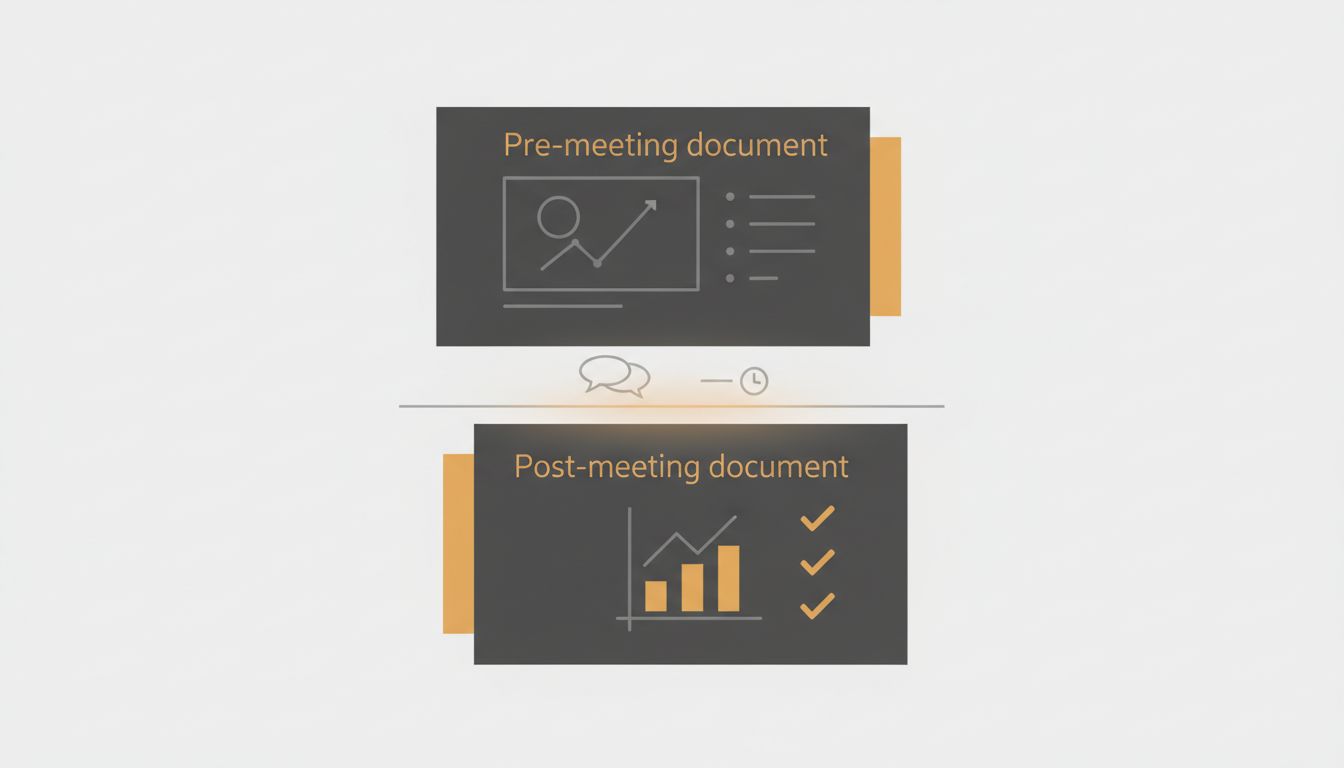
You’ve been in this meeting. Everyone shows up, someone shares their screen, and you spend the first twenty minutes getting oriented to information that could have been pre-read. Then a few people have a productive conversation, a decision gets made, and someone says “I’ll document this and send it around.” The meeting was the middle layer of a process that the document could have handled entirely.
If your meetings consistently require prep materials that attendees haven’t read, or consistently produce follow-up documents that contain the actual conclusions, that’s diagnostic. The meeting is functioning as a forcing function for reading, or as a ritual for making async decisions feel official. Both of those problems have better solutions than a meeting.
Try running the document first. Write up the context, the options, and your recommendation. Share it and ask for responses by a specific time. If you get clear alignment, you never needed the meeting. If you get conflicting feedback that genuinely requires real-time negotiation, now you have a meeting with a defined purpose and people who are already oriented.
5. You’re Calling It a Meeting When You Mean a Conversation
Not every synchronous interaction is a meeting, and treating them the same way creates unnecessary overhead. If you need to think through a problem with one other person, that’s a conversation. It doesn’t need a calendar invite, an agenda, or a Zoom link. It needs fifteen minutes and a willing participant.
The habit of formalizing every interaction into a scheduled meeting creates two problems. First, it delays things that should happen immediately. Second, it trains people to treat their calendar as the only legitimate channel for collaboration, which means anything not on the calendar feels unofficial or ignorable.
A lot of what gets booked as thirty-minute meetings are actually ten-minute conversations that people have convinced themselves require scheduling. If the thing you need to discuss would naturally resolve itself in a hallway or a quick call, treat it that way. Reserve the meeting format for things that genuinely need structure, shared materials, or multiple stakeholders who don’t otherwise interact. As the reasons behind scheduling meetings that should be documents make clear, this conflation is remarkably common and remarkably costly.
6. Nobody Has the Authority to Decide Anything in the Room
This one is easy to overlook because meetings that lack decision-making authority feel productive while they’re happening. People discuss, ideas surface, concerns get raised. Then the meeting ends and whoever actually has authority makes the call, possibly without the benefit of that discussion.
If the decision-maker isn’t in the room, or is in the room but waiting to consult someone else before deciding, the meeting is advisory at best. That’s not necessarily useless, but you should be honest about it. An advisory meeting that doesn’t know it’s advisory wastes everyone’s time pretending toward a conclusion that won’t come.
Before scheduling, confirm that the people who need to decide will be there, and that they have the authority to decide in that session. If they don’t, either restructure who’s involved or restructure the format. A document that collects input and routes it to the decision-maker is often more efficient than a meeting that simulates the same process.
The meeting you canceled last week probably did more good than the one you kept. The question worth sitting with is whether the kept one should have been canceled too.