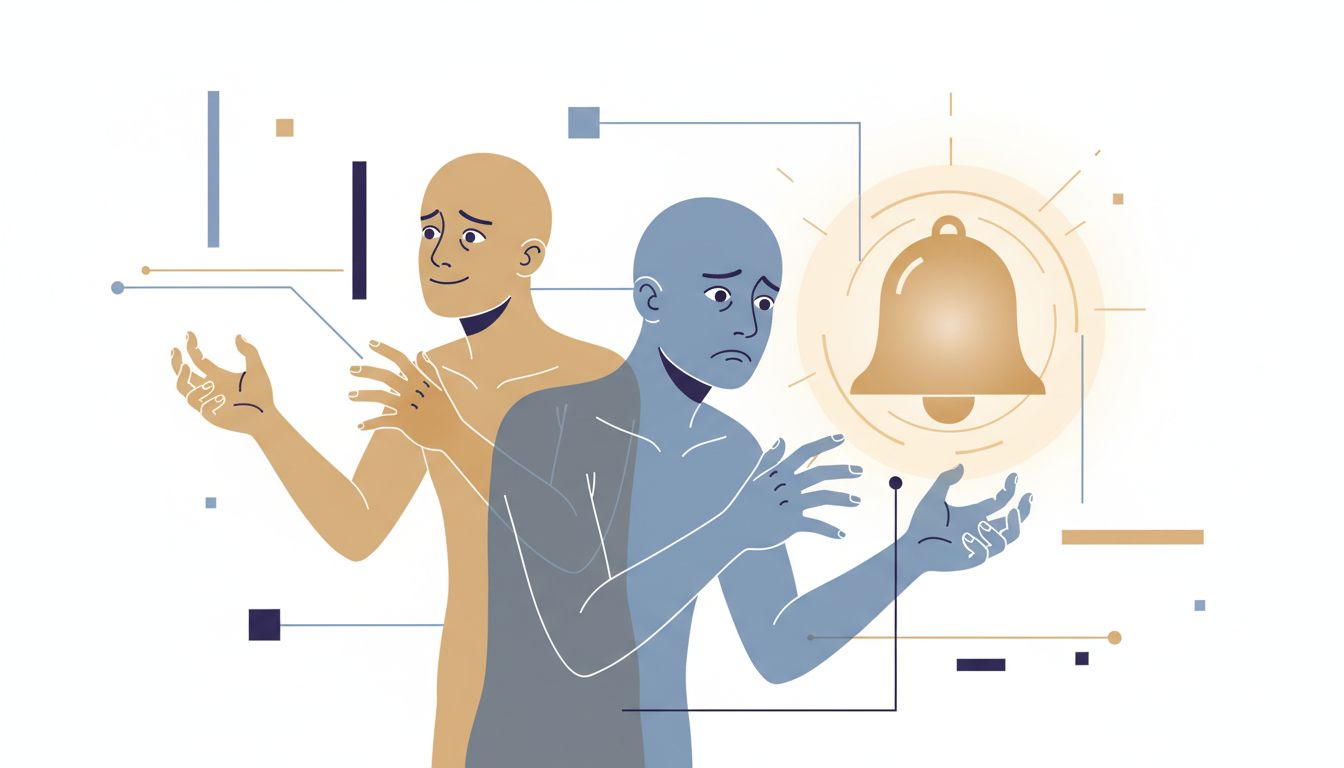
The productivity conversation usually focuses on the interruption itself. Block notifications. Use Do Not Disturb. Close Slack. That’s all reasonable, but it treats the problem as if it ends the moment you tap dismiss. It doesn’t.
1. Attention Doesn’t Snap Back, It Drifts Back
Gloria Mark’s research at UC Irvine found that after an interruption, it takes an average of about 23 minutes to return to a task at the same level of focus. That’s not 23 minutes of idle recovery, that’s 23 minutes of fractured work where you’re technically on task but operating with divided attention. The interrupted thread of thought is still running somewhere in the background, consuming cycles.
Think of it like a browser with too many tabs open. You’re on the page you need, but the others are still loaded. Some are still making network requests. Your conscious attention is here, but your working memory is managing a context switch that never fully completed. The cost isn’t the two seconds you spent reading the notification. The cost is the extended period of degraded performance that follows.
2. The Notification Doesn’t Have to Be Urgent to Be Damaging
Here’s the part that trips people up: the severity of the interruption has almost nothing to do with the cognitive cost. A Slack message that says “let me know when you have a sec” is not urgent. It doesn’t require immediate action. But once you’ve read it, your brain starts modeling it. Who sent this? What do they need? Is this something I should handle before the meeting? How long will it take?
That modeling happens whether you want it to or not. You’ve loaded a new unresolved task into working memory, and it will compete with the work you’re trying to do until it’s resolved or consciously parked. The notification’s content almost doesn’t matter. The act of reading an unresolved prompt is enough to start the clock.
3. Deep Work Has a Startup Cost You’re Paying Repeatedly
Getting into a state of genuine concentration isn’t free. If you’ve ever sat down to work on something difficult and noticed that the first 10-15 minutes feel slow and effortful before you hit your stride, you’ve felt this. The research on flow states suggests that sustained concentration builds on itself, and the early phase of that buildup is the most expensive to repeat.
Every interruption resets that counter. So if you get three notifications across a two-hour block, you haven’t lost three brief moments of attention. You’ve potentially prevented the deep concentration phase from forming at all, or you’ve paid the startup cost multiple times. This is why blocking deep work in theory but executing it poorly doesn’t work. The structure matters, but so does what happens inside the blocks.
4. Checking Once Is Never Checking Once
Notification hygiene usually means silencing alerts. But the subtler problem is the habitual checking behavior that notifications train into us. Once you’ve been interrupted enough times, you start self-interrupting. You check Slack not because it buzzed, but because your brain has learned that it might have something. That’s a conditioned behavior, and it persists even when you’ve turned the badges off.
This is the same mechanism that makes slot machines effective. Variable reward schedules build strong checking habits precisely because the reward is unpredictable. Your phone and your messaging apps are, from a behavioral conditioning standpoint, extremely well-designed slot machines. Removing the lever (the notification) doesn’t immediately remove the urge to pull it.
5. The Meeting-Adjacent Hours Are Almost Entirely Lost
Calendar fragmentation compounds all of this. A 30-minute meeting at 2pm doesn’t just cost 30 minutes. It effectively renders the 45-60 minutes before it nearly useless for deep work, because it’s hard to start something substantial when you know you’ll be cut off. And the 20-30 minutes after a meeting are usually consumed by re-orienting, following up on what was discussed, and gradually re-entering your prior context.
Stack two or three meetings across a day and you can end up with very little usable deep-work time even on a relatively meeting-light day. Notifications operate the same way at a smaller scale. A notification at 10am doesn’t just cost you 10am. If you’re in a deep work block that started at 9:30, the notification may have effectively ended it.
6. Recovery Requires More Than Closing the Tab
The practical implication here is that interruption recovery isn’t passive. You can’t just resume and expect your brain to catch up on its own. Some people find it useful to write down exactly where they were before leaving a task, at the sentence or function level, not just “working on the report” but “was in the middle of the second paragraph making the argument that X.” That kind of explicit state serialization reduces the re-loading cost when you return.
This is also why end-of-day notes or task handoff documents have real value. Your future self has to reload context that your past self held in working memory. The more of that context you write down, the less you pay on re-entry. The principle is similar to what happens with writing things down before a meeting: the act of writing forces you to consolidate what you actually know, and leaves something useful for later.
7. The Fix Is Structural, Not Willpower-Based
Telling yourself to focus harder is not a strategy. The research is pretty clear that the human attentional system is not built for constant task-switching, and willpower is a finite resource that depletes across the day. Trying to white-knuckle your way through a notification-rich environment is fighting your own neurology.
What actually works is reducing the frequency of possible interruptions at the system level. That means scheduled communication windows rather than always-on availability. It means asynchronous-first team norms so that messages don’t carry an implicit expectation of immediate response. It means treating a two-hour focused block as a genuine commitment, not a suggestion that gets pre-empted by anything that arrives in your inbox. The goal isn’t to never be interrupted. It’s to make interruptions happen on your schedule rather than on the sender’s.
The notification you dismissed three hours ago didn’t just cost you a few seconds. It potentially restarted a 23-minute recovery clock, loaded an unresolved task into your working memory, and reset the startup cost on the concentration you’d been building. That’s a significant levy on your actual productive output, and it’s worth treating it like one.