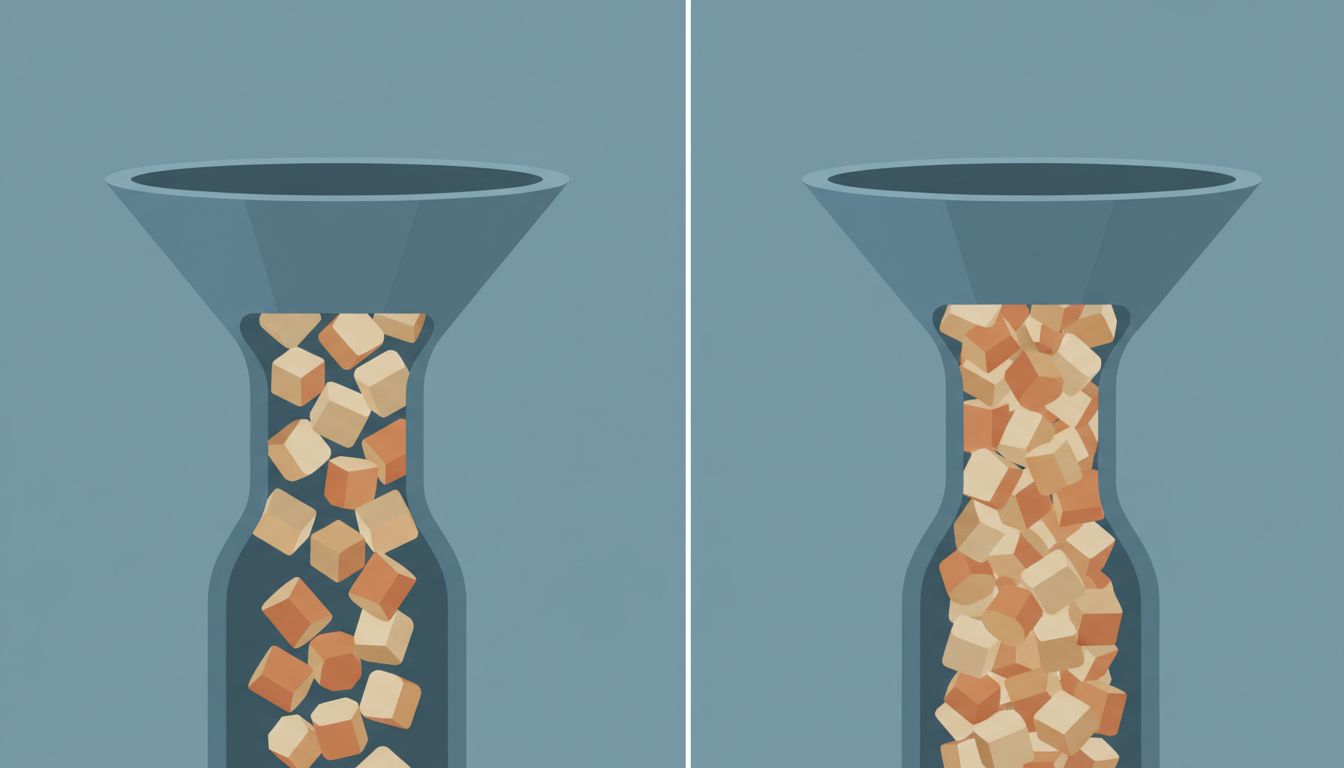

Most productivity systems are secretly optimized for the feeling of progress rather than actual progress. You close the day with fifteen checkmarks and feel good. But if those fifteen items were all shallow, reactive work, you may have spent the day running fast in place.
This isn’t a philosophical observation. It has a mechanical explanation. Here are five reasons why constraining how much you attempt each day tends to produce better outcomes than trying to fit in more.
1. Tasks Have Setup Costs That Don’t Scale Down
Every task you switch to carries a context-loading penalty. For knowledge work, researchers studying task-switching have found that reorienting after an interruption can cost 20 or more minutes of productive momentum, not just the seconds it takes to glance at a new problem. When you stack twelve tasks in a day, you’re not getting twelve units of focused work. You’re getting twelve setup routines, twelve context loads, and whatever shallow thinking survives the transitions between them.
Think of it like database queries. A thousand small queries with no connection pooling is almost always slower than a hundred well-structured queries that reuse state. The overhead dominates. Your brain’s working memory has the same problem: it needs time to page in the relevant context before it can do anything useful, and each switch flushes some of that state.
If you deliberately limit yourself to four or five meaningful tasks, you’re not doing less. You’re spending more time actually executing and less time re-loading.
2. Small Task Lists Force You to Make the Hard Call About What Matters
A twenty-item to-do list is a way of avoiding a decision. You don’t have to choose what’s actually important because you’ve told yourself you’ll do it all. Constraining to five items forces prioritization that a long list lets you defer indefinitely.
This is where the real productivity gain hides. Not in the execution of four tasks instead of twelve, but in the moment where you have to ask: if I can only do four things today, which four move the needle? That question, asked honestly, surfaces a different answer than “what can I tack onto the list.” Your to-do list is architecturally biased against this kind of thinking.
Teams that use strict work-in-progress limits in kanban systems (a practice borrowed from lean manufacturing, where you cap the number of tasks in any given state) consistently report that the constraint itself is productive, because it forces conversations about priority that never happened when the queue was unbounded.

3. Completion Compounds in Ways That Partial Progress Does Not
There’s an asymmetry between finishing a task and getting it 80% done. A finished task can be handed off, shipped, iterated on, or closed. An 80% complete task still owns mental real estate, still shows up in status meetings, still requires you to remember where you left off. The carrying cost of incomplete work is real and largely invisible on a task list.
Software engineers who’ve worked on large codebases know this viscerally. A feature branch that’s been open for three weeks isn’t 90% of the way to done. It’s a merge conflict waiting to happen, a context that needs to be re-established, a dependency that may have shifted under it. The same principle applies to any complex cognitive work. Finishing five things cleanly is worth more than half-finishing ten.
Calendar commitment also matters here. A task you realistically finish today is one that stops consuming planning overhead. A task you carry forward three days running isn’t just incomplete work, it’s a compounding drag on your ability to plan accurately at all.
4. Deep Work Has a Daily Budget, and Shallow Tasks Spend It Fast
Cognitive research on demanding mental work (the kind that produces the outputs most knowledge workers are actually paid for) suggests the available hours for truly high-quality focus are limited per day, somewhere in the two-to-four hour range for most people before quality degrades. Cal Newport’s writing on this is directionally accurate even if the precise limits vary by person.
When you schedule twelve tasks, you’re almost guaranteed to fill your focus budget on tasks three through six and coast on autopilot through seven through twelve. That’s not a willpower problem. It’s just how sustained attention works. Scheduling fewer tasks means more of your focused hours land on work that actually benefits from them, rather than being squandered on the first available item in a long queue.
Most people’s strategies for protecting deep work compound this problem by treating focus blocks as a scheduling trick rather than a budget constraint.
5. Output Quality Degrades When Throughput Is the Goal
When your implicit metric is tasks completed, you optimize for completable tasks. You write the shorter email instead of the clearer one. You close the ticket with a workaround instead of fixing the underlying cause. You review the pull request quickly instead of thoroughly. None of these show up as failures on a task list, but they accumulate as technical debt, communication debt, and relationship debt that surfaces later at higher cost.
This is the throughput trap. Systems optimized purely for throughput tend to sacrifice quality, and knowledge work is no different. A consultant who closes fifty client interactions a week at mediocre depth will lose to one who closes twenty at genuine depth, and the work product shows it. Ambiguity about what “done” means makes this worse: a task ticked off as complete is not the same as a task done well.
The uncomfortable implication of all this is that a productive day might not look productive from the outside. Four tasks completed, each with real depth, each requiring an hour or more of focused work, might produce less visible activity than a day full of quick wins. The fix isn’t to work slower. It’s to measure what the work actually produced rather than how many items moved from one column to another.
Start with a constraint: pick three non-negotiable tasks for tomorrow and don’t add to that list until they’re done. Not as a permanent rule, but as a diagnostic. Notice how differently you engage with each one when you’ve committed to finishing rather than attempting.