The Fantasy System vs. The One You Use
Every few months someone posts their productivity setup online and it gets thousands of saves. Color-coded Notion databases. Obsidian vaults with elaborate graph views linking every book they’ve read to every project they’re running. Morning routines that begin at 5am with journaling, then a workout, then a focused work block, then a review of weekly goals, all before a standup at 9.
You look at it and feel two things simultaneously: genuine admiration and a quiet sense that you are failing at being a person.
Here is what those posts almost never show: whether the system is still in use six months later. Because the elaborate systems, the ones that look like they belong in a productivity influencer’s screenshot portfolio, have a consistent failure mode. They require more energy to maintain than they return. They are beautiful to build and exhausting to operate.
The system that actually works is rarely photogenic. It might be a single text file you’ve been appending to for three years. It might be a worn notebook with inconsistent formatting and coffee stains. It might be a GitHub issue tracker you’re using for personal tasks, which you would never admit to at a dinner party.
Why Engineers Keep Reinventing This Problem
Software people are particularly susceptible to the elaborate system trap. We are trained to build abstractions, to find elegant architectures, to design things that scale. So when we apply that instinct to organizing our own work, we tend to over-engineer immediately.
I’ve watched smart engineers spend entire weekends configuring their task management setup, building custom scripts to sync their todo list with their calendar, writing automation to tag tasks based on project context, and then abandoning the whole thing within two months because it requires constant maintenance. The system became a project in itself, and like many projects, it suffered from scope creep until it collapsed under its own weight.
This is a specific version of a problem that shows up everywhere in software: the tendency to build for the ideal case rather than the actual case. Your real workflow is not the workflow you wish you had. It is messier, more interrupt-driven, and more dependent on context-switching than any clean architecture can gracefully accommodate.
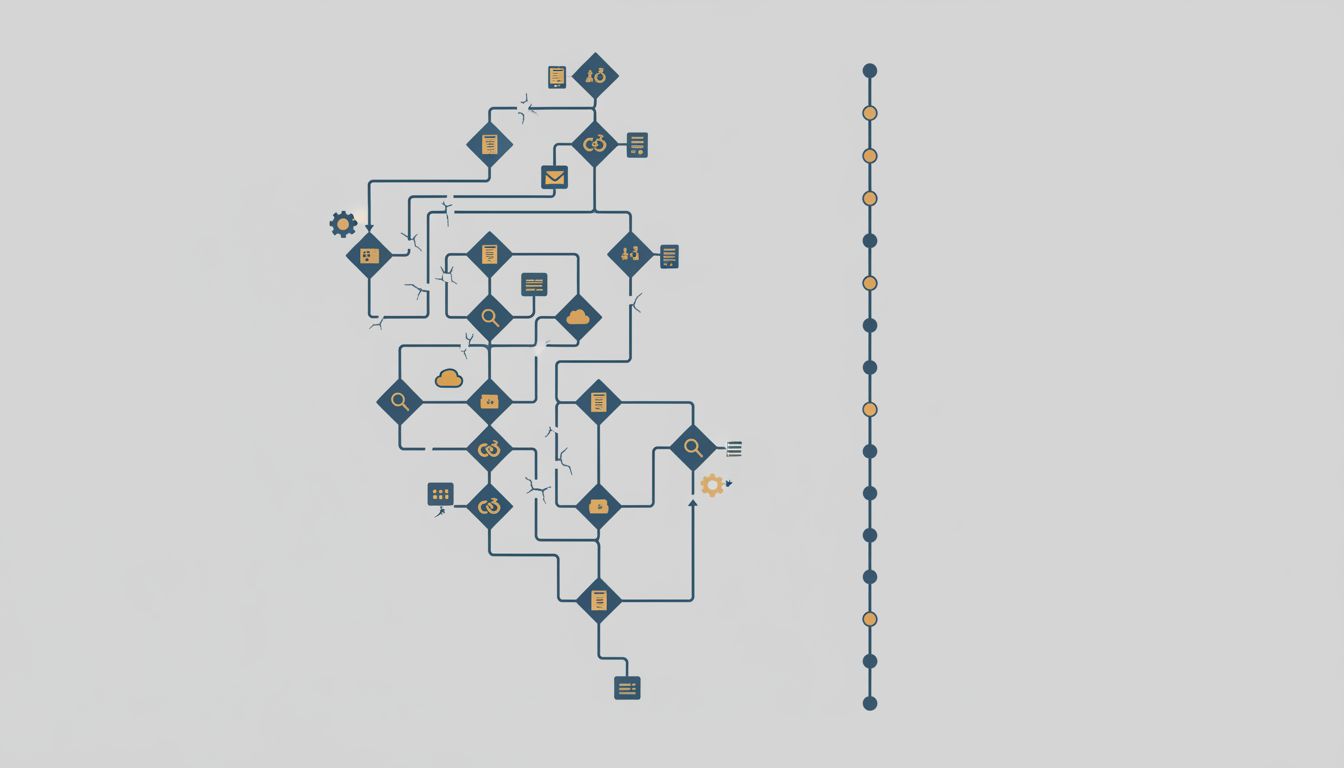
The most durable personal productivity systems share a property with the most durable software: they were built to survive contact with reality, not to describe an idealized version of it.
The Maintenance Cost Nobody Mentions
Every productivity system has what you might call a maintenance tax, the ongoing overhead required just to keep the system functioning, separate from the overhead of using it to actually do work.
A simple text file with dated entries has near-zero maintenance tax. You open it, you write, you close it. There is nothing to update, no schema to conform to, no integrations to repair when an API changes.
A sophisticated Notion workspace with linked databases, formula fields, and cross-page relations has substantial maintenance tax. Pages drift out of sync. Formulas break. You spend Sunday evening reorganizing a structure that felt right in April but doesn’t map to how your work actually flows in October.
The problem isn’t that these systems are bad. It’s that nobody accounts for their total cost of ownership, to borrow a concept from enterprise software evaluation. You see the productivity gains in the marketing (or in the enthusiastic blog post) but not the accumulated cost of keeping the thing alive.
When you factor in maintenance tax, simpler systems frequently outperform sophisticated ones over a timespan longer than three months. The performance gap widens the more chaotic your actual working conditions are, because chaotic conditions are precisely when you have the least energy to maintain an elaborate system.
What Embarrassment Reveals About Fit
Here’s a useful diagnostic: if you would feel embarrassed showing your actual system to someone whose opinion you respect, that feeling is information.
Sometimes the embarrassment signals that your system is genuinely lazy or underdeveloped, that you’ve been meaning to actually write things down but haven’t. That’s actionable feedback.
But more often, the embarrassment comes from a mismatch between what productivity culture says a system should look like and what actually works for your specific brain, your specific work, your specific constraints. You use a paper to-do list with crossed-out items because that physical act of crossing something out gives you a satisfying sense of closure that no checkbox ever has. You feel embarrassed because everyone seems to be using apps.
That embarrassment is mostly noise. The question is not whether your system looks good. The question is whether your system reduces friction between having a thought and capturing it, between capturing a task and completing it, between completing a task and knowing what to do next.
A senior engineer I know kept their entire project context in a single, long Slack message they edited in-place over the course of a week and then copied into a new message when it got too long. Absurd by any formal standard. But they never lost track of what they were doing, and the overhead was essentially zero.
The Goldilocks Problem of Structure
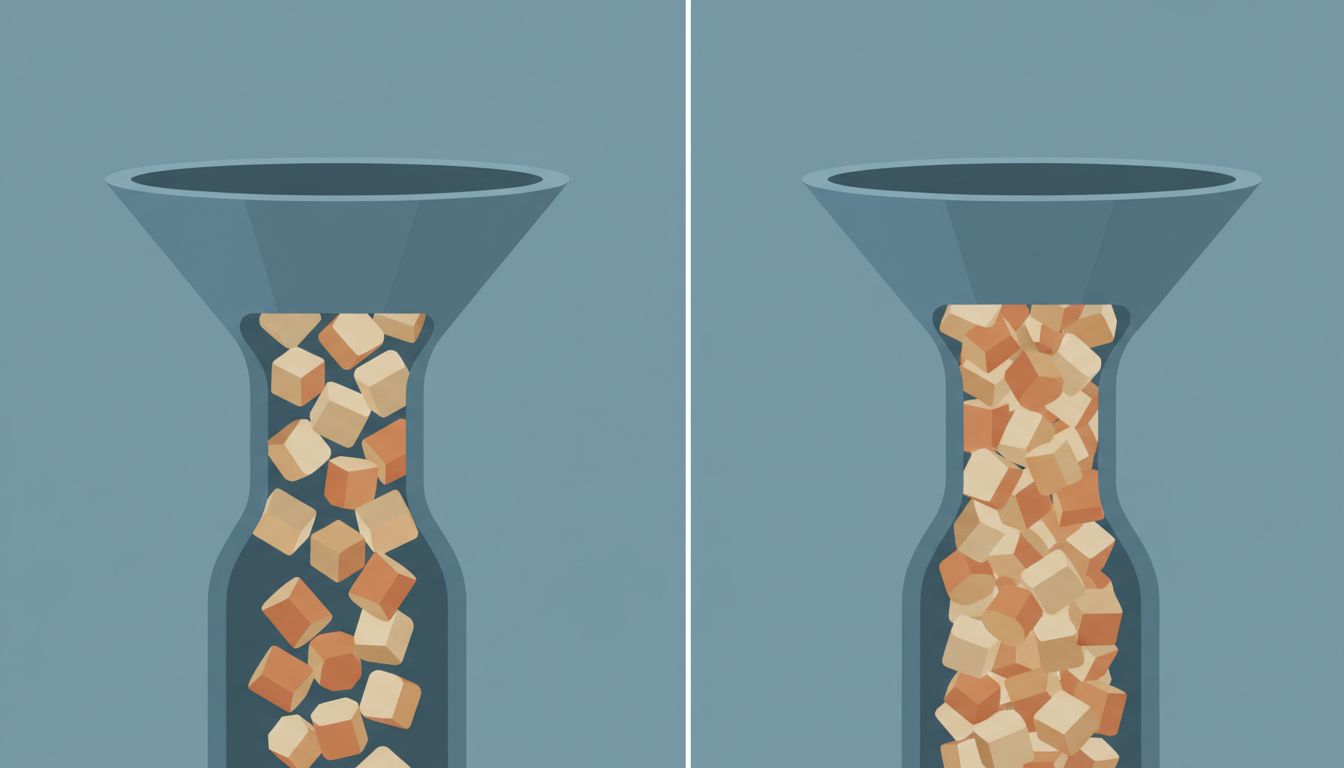
Too little structure and nothing gets captured. Too much structure and the system becomes an obstacle. The right amount of structure is the minimum required to make capture feel easier than not capturing.
This is genuinely hard to calibrate because the right amount is personal and changes over time. It also depends heavily on the type of work you do.
If your work is highly interrupt-driven (support engineering, incident response, management), you need a system that is extremely fast to update and tolerant of partial information. A long-running Zettelkasten with atomic notes and bidirectional links is not that system. A running timestamped log in a text editor probably is.
If your work is deep and sequential (research, writing, complex feature development), you can afford more structure because you have longer uninterrupted periods to interact with it. Your best work lives between the meetings, and if you have enough of that time, you can justify investing some of it in more sophisticated organization.
The mistake is importing a system designed for one work pattern into a context with a completely different work pattern. The system that works for a researcher who has four-hour blocks of focused time every day will fail for a team lead who gets interrupted every twenty minutes.
What Actually Sticks and Why
If you look at what people actually use long-term rather than what they build and then write about, a few patterns emerge.
First, systems that live where the work lives. If your work happens in a terminal, a text file works. If your work happens in a browser, a browser-based tool with low switching cost works. The fewer context switches required to interact with your system, the more you’ll actually interact with it.
Second, systems with a clear capture path. The thing that kills productivity systems is the backlog of uncaptured thoughts. If capturing a task requires more than about five seconds of friction, you’ll defer capture, and deferred capture becomes no capture. The best systems make capture so fast it’s almost reflexive.
Third, systems that tolerate neglect. Life intervenes. You get sick, you go on vacation, work explodes for two weeks, you fall off the system entirely. A system that can be picked back up with minimal reconstruction after a two-week gap is dramatically more valuable than a system that requires daily maintenance to function. This is why simple lists often outperform sophisticated systems: you can always just read a list from the top.
Fourth, and most importantly, systems that match how you actually think rather than how you think you should think. Some people are naturally hierarchical thinkers and do well with nested lists and project folders. Some people think associatively and do better with a flat search-based system where everything is in one place and retrieval is by keyword. Building a hierarchical system when you’re an associative thinker is like trying to navigate a city using only numbered grid coordinates when you actually navigate by landmarks.
What This Means
The productivity system you’ll actually keep is almost certainly less impressive than the one you’d design if you were trying to impress someone. It has fewer features, messier formatting, and probably fewer integrations with other tools. It might be embarrassingly simple.
That’s not a failure condition. That’s the system working as designed, which is to say, designed for you specifically rather than for the person writing the blog post.
Before you build or adopt any system, ask two questions. First: what is the maintenance tax? Not the setup cost, the ongoing cost. Second: does this match how I actually work, or how I wish I worked?
If the answer to the second question is “how I wish I worked,” the system will fail as reliably as software that models the happy path but not the error path. Your actual work patterns are the edge cases your system needs to handle. Build for those first.