
In early 2020, Basecamp published the internal handbook they’d been running on for years. It included a line that most productivity consultants would find alarming: they had eliminated recurring meetings entirely for a stretch of time, replacing synchronous discussion with written asynchronous communication. The result, by their account, was not chaos. It was focus.
This isn’t a story about Basecamp specifically. It’s a story about a pattern that plays out quietly inside product teams all over the industry, usually without anyone naming it explicitly.
The Setup
Consider a mid-sized SaaS company, the kind with thirty engineers, a handful of product managers, and a calendar that has gradually calcified into something resembling a coral reef. Every quarter, someone does a meeting audit, gasps at the numbers, and cancels a few things. Two weeks later, the calendar looks the same.
One team inside this company, a backend infrastructure group of six engineers, reached a different kind of breaking point. They were in the middle of migrating a core data pipeline (essentially the plumbing that moved event data from their user-facing app into the data warehouse) from a legacy batch system to a streaming architecture. The project was three weeks behind. The engineers were frustrated.
The team lead, in a moment of desperation rather than strategic clarity, did something drastic. She canceled every recurring meeting for two weeks. The weekly sync. The cross-team standup. The architecture review. The “alignment” call that no one could explain the purpose of. She kept exactly two things: a daily written check-in posted to a Slack channel at 9am, and an on-demand call that anyone could invoke if they were actually blocked.
She expected pushback. She got almost none.
What Happened
In the first week, the team shipped more than they had in the previous three combined. Not because they were working longer hours. The pipeline migration, which had been stalled on a particularly gnarly schema transformation problem, was resolved on day three of the experiment. The engineer working on it later said the solution came to him during what would have been the Wednesday architecture review slot. He was at his desk, uninterrupted, actually thinking.
This is the part that’s easy to dismiss as anecdote. But there’s a structural reason it’s not.
Deep technical work operates on a different time scale than meeting schedules assume. When you’re debugging a distributed system or designing a schema migration, you’re building a mental model of something genuinely complex. The state of that model lives in working memory. It takes roughly fifteen to twenty minutes of uninterrupted focus to reconstruct that model after an interruption, according to research that’s been replicated enough times across enough contexts to treat as reliable. A one-hour meeting doesn’t cost one hour. It costs the meeting, plus the reconstruction time on either end, plus the context-switching overhead of shifting mental modes.
Calendars optimize for the appearance of coordination. They create the feeling that communication is happening because people are in rooms together. But a lot of what passes for coordination in meetings is actually just status reporting, which is information that could be written down, read asynchronously, and acted on without consuming six people’s afternoons simultaneously.
The team lead had accidentally run a controlled experiment. She hadn’t changed the work. She hadn’t added engineers (which, as Brooke’s Law predicts, would have made things worse anyway). She had simply removed the tax.
Why It Matters
The interesting lesson here is not “have fewer meetings.” That’s the headline version, the thing you put on a slide deck. The real lesson is about what meetings actually do versus what we believe they do.
Meetings serve several legitimate functions: resolving ambiguity that’s genuinely blocking progress, making decisions that require negotiation between stakeholders, and maintaining the social fabric of a team that needs to function as a unit over time. Those are real. Those meetings should exist.
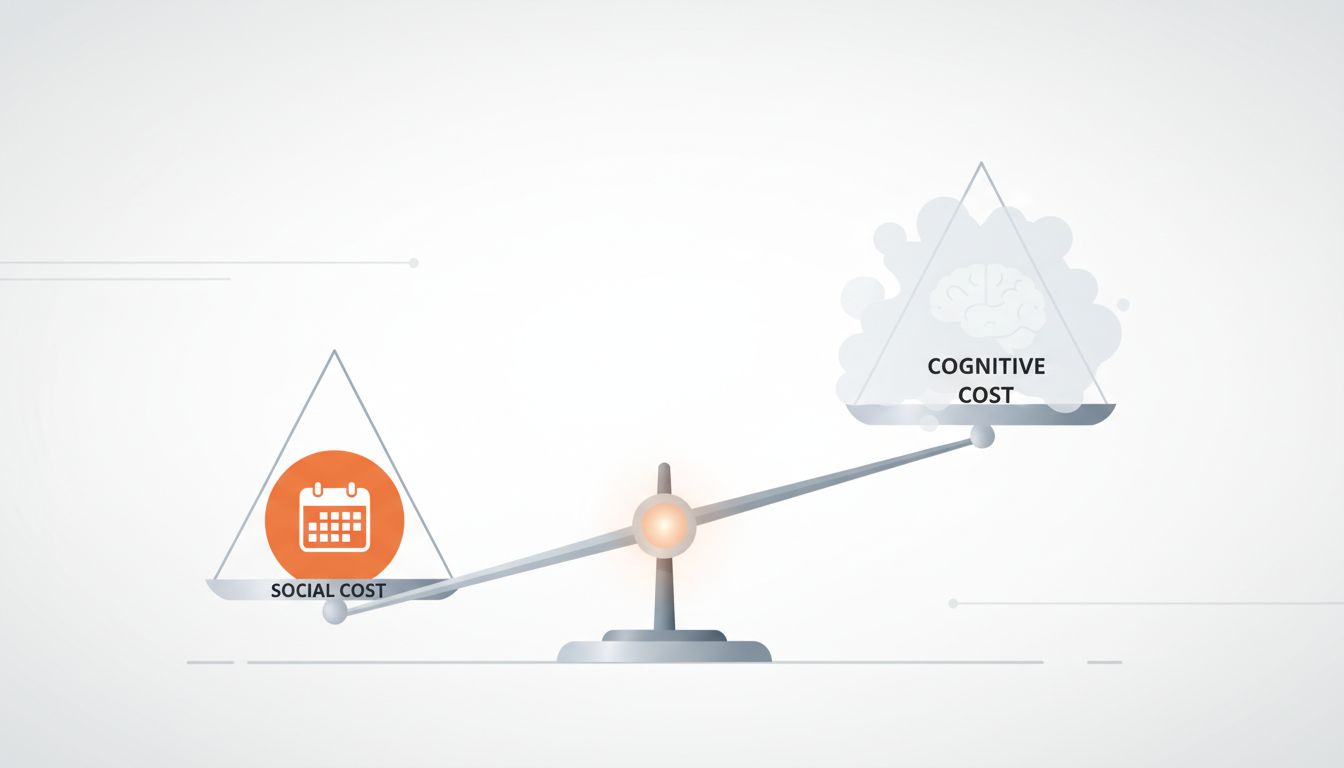
But a large fraction of recurring meetings serve none of those functions. They exist because someone scheduled them once, they become load-bearing through habit, and canceling them feels like a signal that you don’t value coordination. The social cost of canceling a meeting is high. The cognitive cost of attending it is invisible because it’s distributed and delayed.
This asymmetry is the core problem. If you cancel a meeting, someone might feel slighted or wonder if the project is drifting. If you attend a useless meeting, three engineers lose an afternoon, but the damage doesn’t show up anywhere obvious. It just becomes part of the background hum of a project being slower than it should be.
The infrastructure team’s experiment made the invisible visible. When the two-week period ended and the lead surveyed the team about which meetings to restore, almost everyone struggled to justify the recurring ones. The architecture review came back, but monthly instead of weekly, and with a written agenda required in advance. The cross-team standup was replaced with a shared document that each team updated on Fridays.
What We Can Learn
The practical takeaway isn’t to cancel everything. It’s to distinguish between meetings that resolve active ambiguity and meetings that perform coordination without producing it.
A useful test: for any recurring meeting, ask what decision or unblocking it has produced in the last four occurrences. Not what was discussed. What was decided or resolved that couldn’t have been handled in a written thread. If the answer is “mostly status updates,” the meeting is doing work that a document could do at a fraction of the cost.
The second thing worth internalizing is that asynchronous communication is not a lesser substitute for meetings. It’s a different tool with different properties. Written communication forces clarity. You can’t rely on a nod or a vague gesture to paper over an ambiguity. When you write down a decision, it becomes inspectable and revisitable in a way that a verbal agreement in a conference room is not. Your to-do list has a similar problem with work that accumulates without resolution. Both are systems that need periodic hard pruning, not just maintenance.
The infrastructure team shipped their pipeline migration eleven days after the experiment started. The original estimate, before the meeting pause, had suggested another six weeks.
The team lead did not get a productivity award. She did not write a blog post. She just quietly restructured how the team operated, and the project got done. That’s the least glamorous version of this story, and probably the most honest one.