
There’s a particular kind of meeting that never gets questioned. It’s been on the calendar so long that removing it would feel like dismantling part of the office furniture. People have built their Tuesdays around it. A shared document exists solely to feed it. And when someone finally asks “what would happen if we just… didn’t have this?” the room gets quiet in a way that suggests the answer is “nothing, probably.”
That silence is worth paying attention to.
The meetings you can cancel freely are fine. Someone proposed them for a specific reason, that reason resolved itself or didn’t, and the meeting disappears. No drama. The meetings that feel impossible to cancel are a different creature entirely. They’ve accumulated organizational weight that has nothing to do with their actual value. Understanding how that happens, and what to do about it, is one of the more underrated productivity skills you can develop.
How Meetings Become Permanent Fixtures
Most recurring meetings start with a legitimate problem. A team was misaligned, so someone scheduled a weekly sync. A project was drifting, so a status meeting appeared on Fridays. A stakeholder needed visibility, so a monthly review got added. These are reasonable responses to real friction.
The problem is that meetings don’t expire automatically. The misalignment gets resolved, the project ships, the stakeholder moves to a different team, and the meeting keeps going. Nobody cancels it because nobody wants to seem like the person who killed collaboration. The meeting becomes a kind of ambient reassurance that coordination is happening, even when the coordination it was meant to provide is no longer needed.
This is compounded by calendar software that makes recurring meetings trivially easy to set up and quietly hard to kill. Creating a weekly recurring event takes about fifteen seconds. Deciding to end one requires a conversation, a justification, and someone willing to be the person who made that call.
Over time, these fossilized meetings accumulate. And because they’re already on the calendar, they serve as convenient anchors for discussions that could happen in other, lighter-weight ways.
The “What Would We Lose” Test
Here’s the most useful question you can ask about any meeting that feels uncancellable: if this meeting didn’t exist, what would actually break?
Be specific. Not “communication would suffer” or “we’d be less aligned,” but concretely: which decisions would go unmade, which people would be uninformed about what, and how long would it take before that caused a real problem?
If you can’t answer that specifically, you have a strong signal that the meeting is doing less work than it appears to be. Many meetings feel load-bearing but are actually decorative. They give people the sensation of coordination without producing much of it.
The meetings that pass this test tend to share a few characteristics. They have a clear owner who would genuinely feel the loss. They produce decisions or commitments that get acted on. They contain information that isn’t available anywhere else and that someone would actively seek out if the meeting didn’t exist.
Meetings that fail the test tend to be about status updates that could be a written summary, alignment conversations where nobody’s position actually changes, and check-ins where the real purpose is social reassurance rather than information exchange. None of those are worthless human activities. They’re just inefficient ways to do them.
Why Status Updates Deserve Special Scrutiny
A significant portion of meetings that feel impossible to cancel are, at their core, status update vehicles. Someone senior wants to know where things stand, so a weekly meeting exists to provide that visibility.
The problem is that a meeting is a terrible format for status updates. It requires everyone to be present simultaneously, it puts the recipient in a passive role while presenter after presenter takes the floor, and it encourages verbal summaries that are harder to reference later than written ones.
Asynchronous written updates handle this better in almost every case. They’re searchable, they don’t require schedule coordination, they give people time to read carefully rather than listen distractedly, and they create a record that a meeting rarely does. Tools for this range from simple shared documents updated on a cadence to purpose-built software, but the format matters less than the habit.
If your uncancellable meeting is primarily a status update delivery mechanism, the right fix isn’t a better meeting. It’s replacing the meeting with a written update that the relevant people can read when it suits them. Yes, this requires buy-in from whoever receives the update. Getting that buy-in is worth the effort.
The Sunk Cost Problem in Calendar Management
One reason meetings calcify is that the people in them have invested time in them. Not just in attending, but in preparing for them, in building workflows around them, in treating them as coordination infrastructure. Admitting a meeting is no longer valuable means admitting that all that investment was, at least partially, wasted.
This is a version of sunk cost reasoning, and it functions the same way here as it does in product decisions or engineering choices. The time you’ve already spent doesn’t change the value of continuing. Deleting something that once mattered is always harder than it should be, whether that thing is a product feature or a Tuesday afternoon calendar block.
The practical antidote is to evaluate meetings prospectively rather than retrospectively. The question isn’t “has this meeting been valuable?” but “will this meeting be valuable going forward, and is it the most efficient way to accomplish what we need?” Those are different questions, and the second one is harder to answer sentimentally.
How to Actually Audit Your Recurring Meetings
Start with a list. Pull up your calendar and write down every recurring meeting you attend. Include the ones you host and the ones someone else organized but where your attendance is expected.
For each one, answer three questions:
First: what is the specific output this meeting produces? Decisions made, commitments recorded, information exchanged that couldn’t have moved another way. If you can’t name it, that’s a flag.
Second: who would notice if this meeting didn’t happen, and what would they actually do about it? If the answer is “nobody would do anything differently,” the meeting is serving a psychological function more than a practical one.
Third: is the meeting format the most efficient way to accomplish what it accomplishes? Could a short written update replace a status sync? Could an async comment thread replace an alignment meeting? Could a shared document with a clear owner replace a weekly review?
You’ll find that some of your recurring meetings are clearly worth keeping. A well-run one-on-one with a direct report, a design review that produces real decisions, a retrospective where process actually changes. Keep those, and protect them. The value of your best work lives in the gaps around the right meetings, not in eliminating all of them.
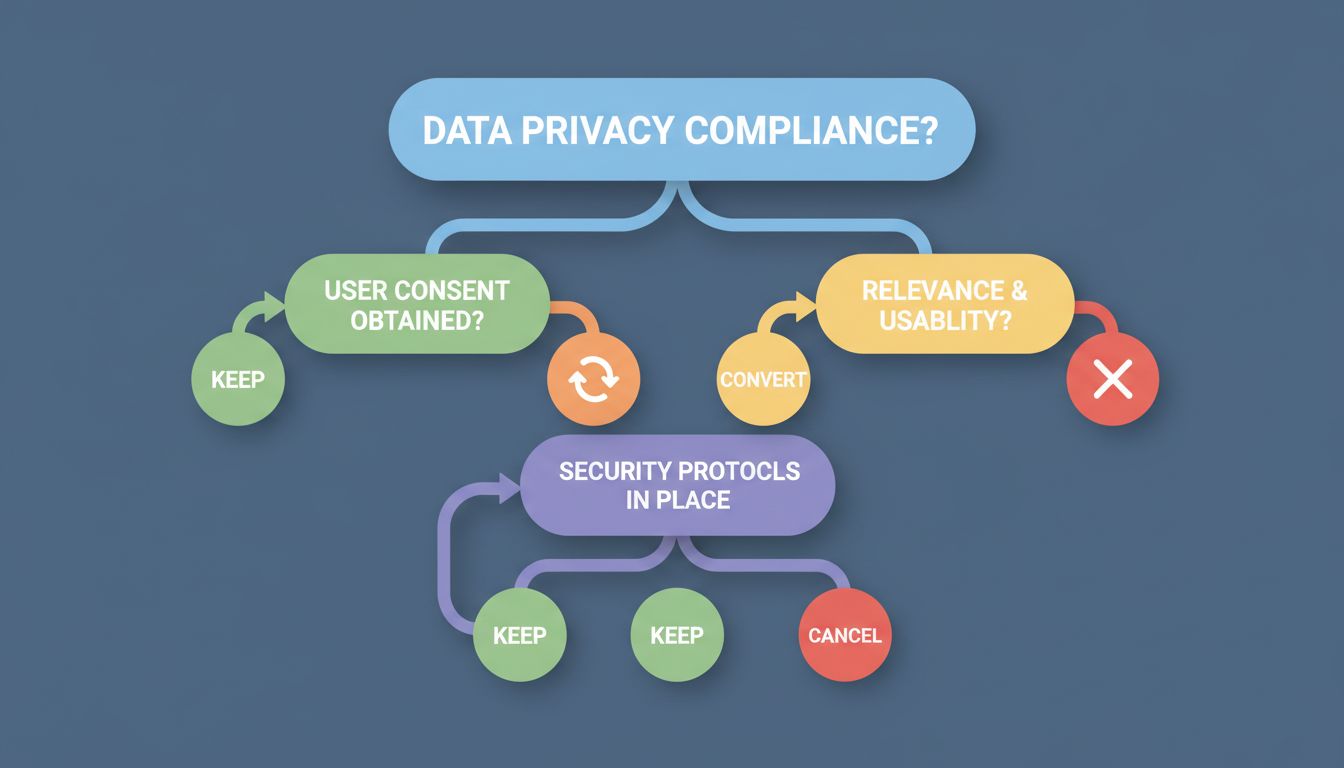
The others, you handle one of three ways: cancel them outright, convert them to async, or change their frequency. A weekly meeting that survives the audit might still work better as a monthly one.
Getting Organizational Buy-In for the Hard Cancellations
Some meetings you can cancel unilaterally. If you own it and host it, you can simply stop scheduling it, send a note explaining what you’re replacing it with, and move on. That’s the easy case.
The harder case is a meeting someone else owns where your attendance is expected. Here you have a few options. You can have a direct conversation with the organizer about whether your presence is actually necessary, and often it isn’t. Many people invite more people than they need because inclusion feels safer than exclusion, and a polite conversation can free you without offending anyone.
You can also propose a trial absence. “Let me skip the next two sessions and we’ll see if anything breaks” is a low-stakes experiment that tends to produce honest data quickly. If nothing breaks, you have your answer. If something does break, you’ve learned that your presence matters and can make an informed choice about whether to return.
What you want to avoid is the silent protest: attending but disengaged, checking email, doing other work while nominally present. That’s costly in its own way. It takes time, fragments your attention, and signals to everyone in the room that the meeting isn’t worth their full engagement. If you’re going to be in a meeting, be in it. If you can’t justify being in it, don’t be.
What This Means for How You Manage Your Calendar
The practical upshot is this: treat your calendar as an artifact that requires active maintenance, not passive accumulation. Every quarter, run the audit above. Give every recurring meeting a simple test: what breaks if we stop? If the answer is nothing, stop.
Build in expiration dates when you create new recurring meetings. When you schedule a weekly project sync, name the condition under which it will end. “We’ll run this until the feature ships” or “let’s revisit this in six weeks and see if we still need it.” Meetings with clear end conditions are much easier to cancel than meetings with no defined purpose.
And when someone asks to schedule a meeting, ask what they’d do if you couldn’t attend for two weeks. If the answer is “send you an update,” suggest you start there and schedule a meeting only if the update raises something that needs real-time discussion.
The meetings you can’t cancel are the ones most worth examining. They’ve usually survived not because they’re necessary, but because nobody has been willing to ask whether they are.