The Tool That Talks to Itself
There is a category of software bug that should not exist. Not because it’s obscure or hard to reproduce, but because a tool already told someone about it before the code ever ran. The compiler flagged it. The linter underlined it. The static analyzer filed a report. Then a developer dismissed the warning, or the team configured the tool to stay quiet, and the bug shipped anyway.
This is not a fringe problem. IBM’s Systems Sciences Institute estimated decades ago that a bug found in production costs roughly six times more to fix than one caught during implementation. The ratio has held up well enough that it’s become a fixture of software engineering arguments. More recently, Microsoft has attributed a significant share of its critical security vulnerabilities to memory safety issues that type-safe languages and static analysis tools are specifically designed to prevent. The knowledge to catch the problem existed. The workflow to act on it often didn’t.
The question isn’t whether these tools work. They do. The question is why the industry treats them like a suggestion box.
Warning Fatigue Is Real, but It’s Not an Excuse
The most charitable explanation for developer indifference is warning fatigue. Configure a linter aggressively on a legacy codebase and you might surface thousands of warnings on day one. Developers learn quickly that most of them are noise, and they start treating the whole channel as noise. This is rational behavior in response to a bad configuration, but it gets mistaken for a verdict on the tools themselves.
The Go programming language made a deliberate design choice here: unused variables are compile errors, not warnings. The code will not build. There is no way to ignore the issue and ship anyway. Python and JavaScript tolerate unused variables silently. Go’s approach feels strict until you realize how many hours developers spend tracing bugs that started with a variable they thought they were using but weren’t. The language made the cost of ignoring the signal too high to pay.
TypeScript took a different path toward the same goal. Microsoft released it in 2012 specifically to impose type discipline on JavaScript codebases, where the absence of static types was generating a predictable class of runtime errors. Adoption was slow until large projects, including Angular’s rewrite in 2016, demonstrated that the upfront investment in type annotations paid off in fewer runtime surprises. The tooling wasn’t the obstacle. The workflow that treated type errors as optional was.
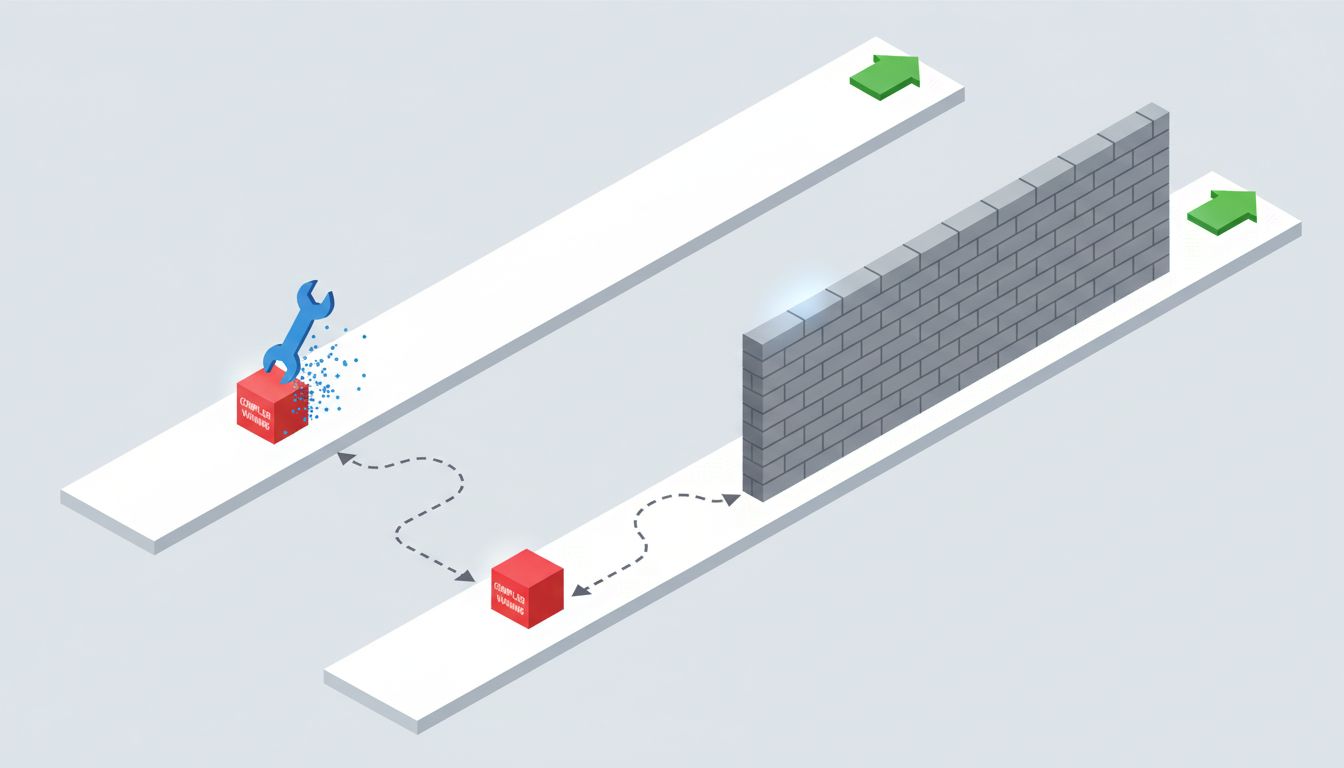
The Architecture of Avoidance
Organizations develop elaborate systems for ignoring compiler feedback. The most common is the suppression comment: a line of code whose entire job is to tell the analysis tool to look away. In many codebases these accumulate like unpaid bills. The suppressions are often added under deadline pressure and rarely revisited. The original developer who added one is usually not the one who encounters the bug it was hiding.
There’s also a subtler pattern involving the division between writing code and reviewing it. Static analysis findings are most useful when they appear in the same moment a developer is thinking about the problem. Many teams run their analysis tools in CI pipelines, which means the feedback arrives minutes or hours after the code was written, in a context where the developer has moved on mentally. The friction of context-switching back to fix a warning that isn’t blocking deployment is often enough to defer it indefinitely, as discussed in the context of how fixing one problem can destabilize surrounding code.
The tooling vendors have understood this for years. The modern development environment integrates analysis directly into the editor, flagging problems as you type. But integration doesn’t guarantee attention. A red underline that appears and disappears as you edit teaches developers to wait it out rather than fix the root cause.
What Rust Actually Proved
The most persuasive case for taking compiler feedback seriously isn’t academic. It’s Rust.
Rust’s borrow checker is a static analysis system built into the compiler that tracks memory ownership at compile time. It prevents entire categories of bugs: use-after-free errors, data races, null pointer dereferences. It does this by refusing to compile code that violates its rules. The borrow checker does not warn. It blocks.
The early reputation of Rust among developers was that it was exhausting. Programmers used to C or C++ reported spending hours arguing with the compiler over ownership rules that felt arbitrary. The feedback loop was adversarial. Then something shifted. Developers started reporting that after learning to satisfy the borrow checker, they stopped spending time debugging entire categories of problems that had previously consumed significant parts of their working week. The upfront cost was real. The downstream cost it was eliminating was larger.
Google, Microsoft, and the Linux kernel project have all made commitments to Rust for systems code specifically because of this property. Microsoft’s security team has stated publicly that roughly 70% of the CVEs they address each year involve memory safety issues that Rust’s type system would prevent at compile time. That number represents real engineers, real incident responses, and real user exposure. It also represents a cost that compilers were already equipped to prevent.
The Discipline Problem Is Organizational, Not Technical
Developers who ignore compiler warnings are not, in most cases, reckless. They are responding to incentives. When a team measures velocity by features shipped and not by bugs prevented, the calculus around warnings shifts. Addressing a static analysis finding that isn’t causing a visible problem today costs time that could produce something demonstrable. The warning loses.
This is the same dynamic that drives teams toward tests that pass while software remains broken. The metric gets satisfied while the underlying goal doesn’t.
The organizations that use static analysis most effectively tend to treat compiler findings as a first-class part of the definition of done, not an optional quality gate. They configure their tools carefully to minimize noise on the signals they actually care about, they integrate findings into the development environment rather than the CI pipeline, and they make suppression comments require justification in code review. None of this is technically complex. All of it requires agreement that the compiler is trying to tell you something worth hearing.
The compiler doesn’t care whether the deadline is real or artificial. It doesn’t distinguish between a critical production service and a weekend project. It simply knows, with considerable precision, that something in the code doesn’t add up. The question of whether to act on that information is entirely human, which means the failure to do so is also entirely human.