
You opened that document to write. Forty minutes later, you’ve answered six messages, skimmed a report you didn’t need to read yet, and opened a new tab to look up something that led somewhere else entirely. The writing: two sentences.
This isn’t a discipline problem. It’s a structure problem. Knowledge workers don’t lose attention because they’re lazy. They lose it because the cognitive architecture of modern work actively pulls attention away from the task that matters. Here’s where it actually goes.
1. The Opening Ritual Eats the First Thirty Minutes
Before most knowledge workers touch their actual work, they run a circuit. Email, then Slack (or Teams), then a quick calendar check, then back to email because something new arrived. This circuit feels productive because it clears things. It isn’t. It burns your sharpest cognitive hours on low-value routing decisions.
Gloria Mark’s research at UC Irvine has documented this extensively: after an interruption, it takes an average of over 23 minutes to return to a task at full engagement. The opening ritual isn’t one interruption. It’s a cascade of them, front-loaded into the part of the day when your working memory is strongest. You’re spending premium attention on triage.
The fix is boring but it works: defer the circuit. Open your primary task first. Give it 60 to 90 minutes before you check anything else. Most things that arrived overnight can wait until 10am. Almost nothing that arrives during your first hour requires a response within that hour.
2. Task-Switching Disguised as Multitasking
Knowledge workers routinely describe themselves as multitasking. They aren’t. The human brain doesn’t run parallel threads on complex cognitive work. What’s actually happening is rapid task-switching, and each switch carries a cost: a reset period where you’re neither fully on the old task nor fully on the new one.
The tricky part is that task-switching feels like progress. You responded to four messages, started a slide, commented on a doc, and attended a standup. You were in motion all morning. But motion isn’t output. A programmer who switches between five open tickets is often slower than one who closes two before touching the others. The same applies to any knowledge work involving sustained reasoning.
If you want to actually see this in your own work, try logging your tab switches for one hour. Not as a guilt exercise, but as data. Most people are surprised by the frequency. Awareness alone tends to reduce it.
3. The “Quick Check” That Isn’t
Notification badges are designed to create a sense of unresolved tension. A red dot on an icon doesn’t just inform you that something arrived. It creates a low-grade urgency that competes with whatever you’re currently doing. This is not accidental.
The “quick check” problem is that checks are rarely quick in practice. You glance at a Slack notification, see a question that requires thought, start composing a reply, realize you need to look something up, open another tab, and surface ten minutes later with three browser tabs open and no memory of what you were doing before the check. The check itself took 45 seconds. The recovery took the rest.
Turn off notification badges for everything except genuinely urgent channels. If your organization has no genuinely urgent channels (most don’t), turn off all of them during your primary work blocks. You can check on your own schedule. You trained this reflex yourself, and you can untrain it.
4. The Rewrite Loop Is Usually Avoidance
Here’s a specific pattern worth naming: the document you keep opening and closing without meaningfully advancing. You read what you wrote last time, make small edits, rearrange a paragraph, change a word, and close it again. Progress feels like it happened. It didn’t.
This often isn’t about the writing. It’s about the underlying decision or commitment the writing represents. A strategy document requires a strategic position. A proposal requires believing in a recommendation. If you haven’t resolved the underlying question, you’ll keep polishing the container without filling it. The task you keep rewriting is often the one you’re avoiding.
The practical move: when you notice the rewrite loop, stop and write one sentence stating the actual decision you haven’t made. That’s usually the real work. The document is downstream of it.
5. Ambient Communication Creates a Second Job
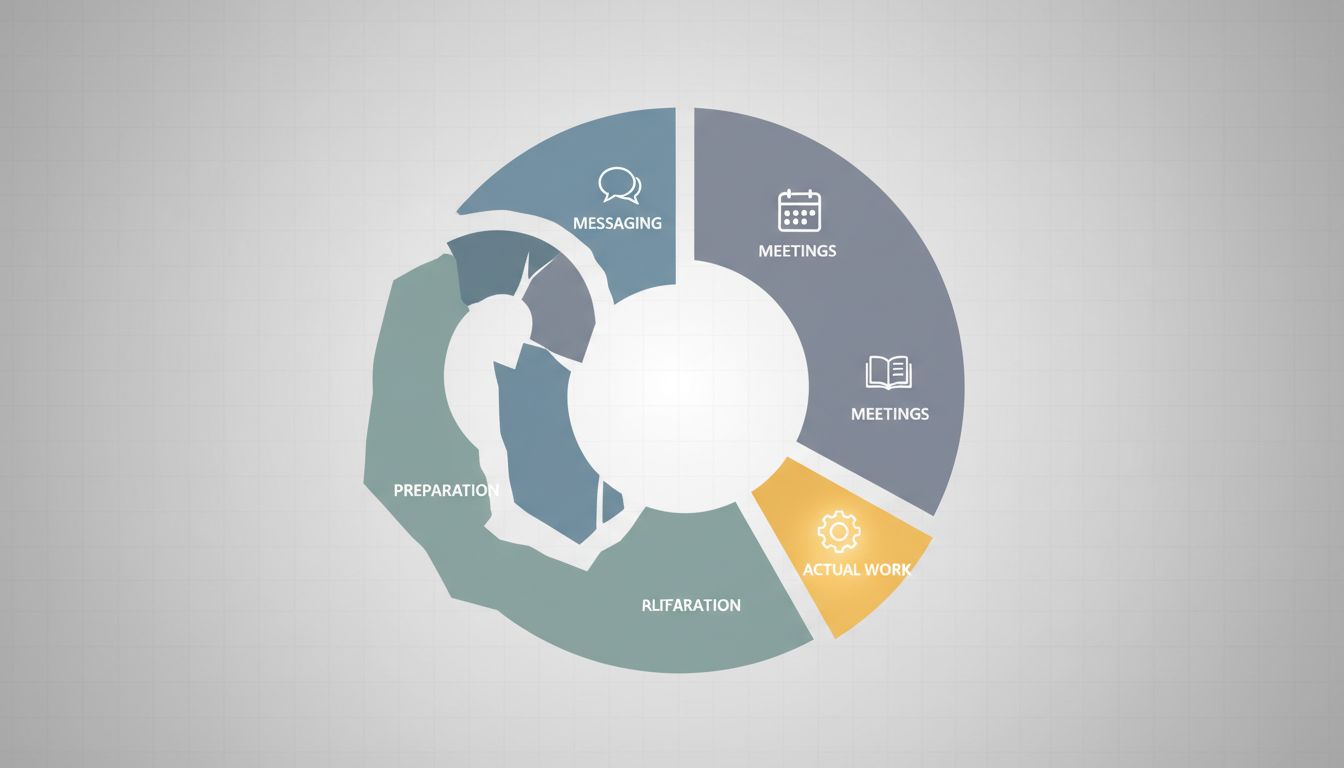
For many knowledge workers, there’s the job they were hired to do, and then there’s the job of staying current in communication channels. These are increasingly in conflict. Responding to Slack messages, staying on top of email threads, commenting in shared documents, attending synchronous meetings that could have been async updates. This communication overhead isn’t trivial.
Researchers at McKinsey estimated that knowledge workers spend roughly 28 percent of their workweek on email alone. Add Slack, add meetings, and for many people the communication job is larger than the actual job. The work that requires uninterrupted thinking, the work that actually builds something, gets pushed to evenings and early mornings when the channels go quiet.
The structural fix here is harder than anything individual. It requires team agreements, not just personal habits. But you can start by auditing your own contributions: how many messages do you send that create downstream attention costs for others? Fewer, better-considered messages tend to generate fewer replies.
6. Preparation Tasks Substitute for the Hard Thing
Organizing notes before writing. Building the perfect project folder before starting the project. Re-reading reference material before making the decision. These feel like prerequisites. Often they’re substitutes.
Preparation has legitimate value, but it has a ceiling. At some point you know enough to start, and continuing to prepare is a way of staying in a comfortable, low-stakes activity while the uncomfortable high-stakes work waits. The tell is when preparation loops back on itself: reorganizing the same notes you organized last week, re-reading sources you’ve already read.
Set a time limit on preparation. Give yourself fifteen minutes to gather what you need, then start. The gaps in your preparation will surface naturally as you work, and you can fill them then, when they’re specific and necessary rather than speculative.
The common thread across all of these is that they’re not failures of willpower. They’re rational responses to a work environment built to interrupt you, combined with cognitive tendencies that make initiation and sustained focus genuinely hard. Understanding where your attention is actually going is the first useful step. Most people, when they look honestly at a day, find that they spent only a few hours doing what they’d describe as their real work. The rest was overhead and drift.
Knowing that won’t fix it automatically. But it gives you something to work with.