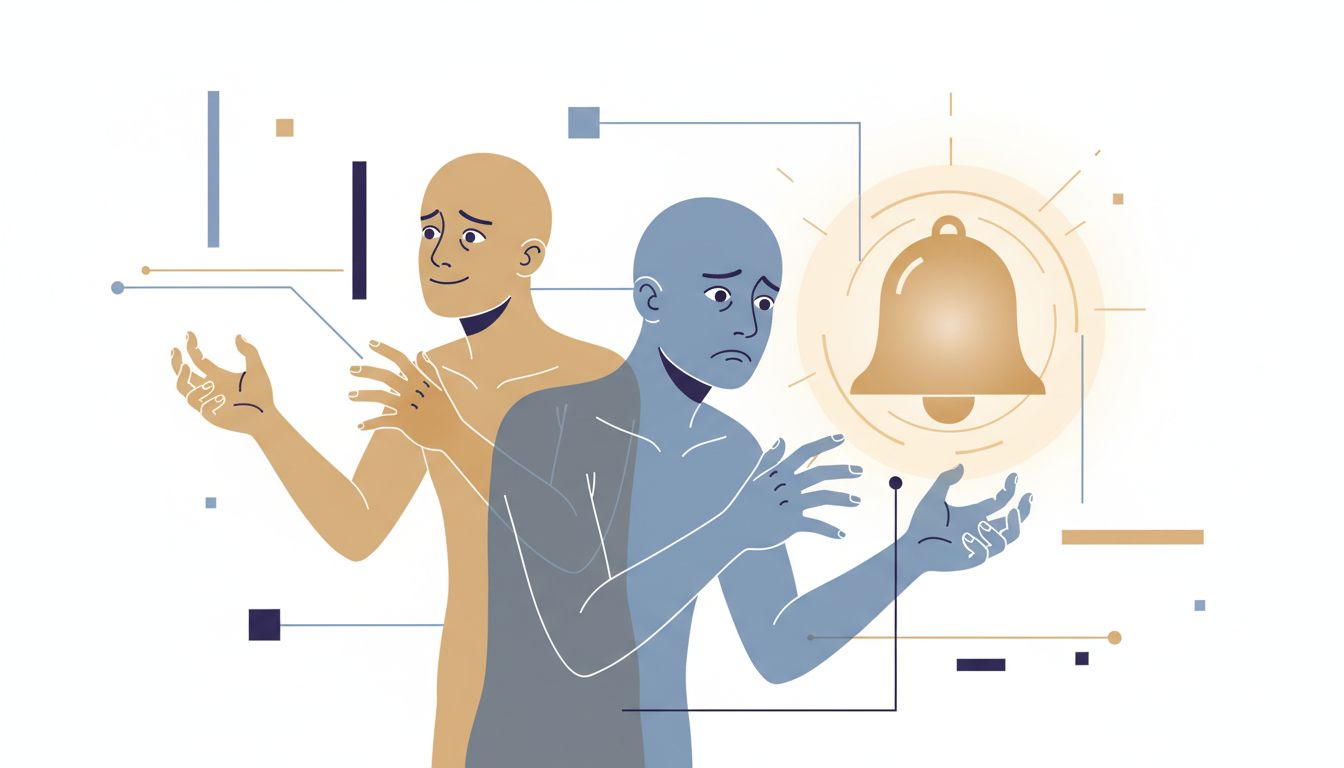

Telling someone to “just focus” when they’re struggling with context switching is like telling someone to “just relax” during a panic attack. It names the desired outcome while ignoring the mechanism. Worse, it implies the problem is moral rather than mechanical. You’re not distracted because you lack discipline. You’re distracted because your brain is doing exactly what it was built to do, and your work environment is exploiting that.
The productivity conversation needs to move past willpower and into neuroscience. Once you understand what’s actually happening when you switch tasks, you can build systems that work with your brain instead of against it.
Switching Isn’t Instantaneous. There’s a Penalty.
When you shift attention from one task to another, your prefrontal cortex doesn’t simply swap one context for another the way a computer loads a new file. Researchers at the University of Michigan, including David Meyer and David Kieras, established in the late 1990s that even brief mental blocks created by task-switching can cost you significant time. Their work showed that people who multitask on complex tasks can lose more than 40 percent of their productive time compared to focusing on one task at a time.
The mechanism matters here. Your brain maintains something neuroscientists call a “task set,” a collection of rules, goals, and contextual priming that orients your thinking toward a specific problem. When you switch tasks, the old task set doesn’t disappear immediately. It lingers. This is sometimes called “attention residue,” a term coined by organizational psychologist Sophie Leroy. Her research showed that when you move from Task A to Task B, part of your cognitive resources stays stuck on Task A, especially if Task A was unfinished. The result is that you’re physically present on Task B but mentally distributed across both.
This isn’t a bug you can patch with better habits. It’s a feature of how working memory functions.
Interruptions Are Worse Than You Think, and You Recover Slowly
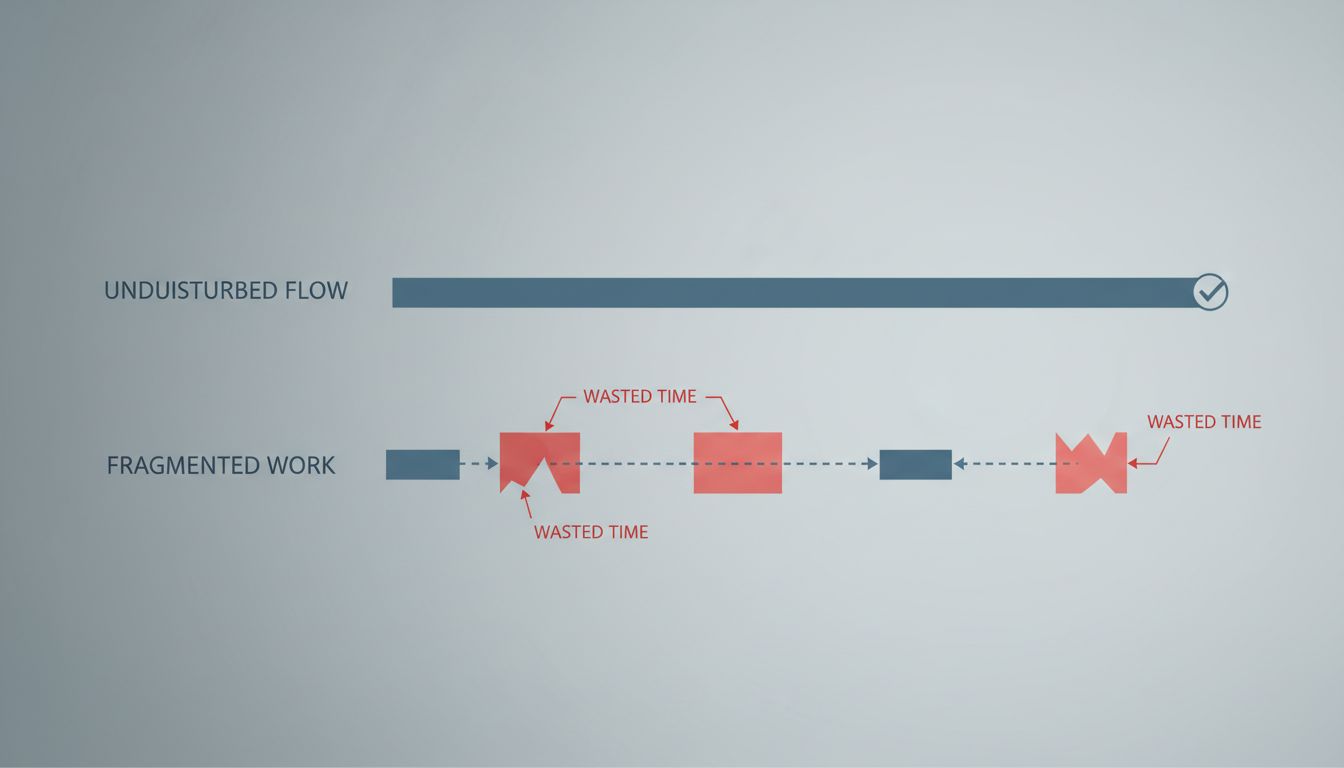
Gloria Mark at UC Irvine has spent years studying interruption patterns in real office environments. Her research found that after an interruption, it takes workers an average of over 23 minutes to return to their original task. That number tends to shock people, and it should. A single Slack message that takes 30 seconds to read and answer can consume 24 minutes of net productivity.
Why so long? Because returning to a complex task requires reconstructing the mental model you had before the interruption. If you were debugging a function, mid-thought, and someone pulled you out, you don’t just pick up where you left off. You have to rebuild the scaffolding: what file were you in, what hypothesis were you testing, what variable behavior seemed strange. That reconstruction is expensive, and it degrades with each subsequent interruption.
Your notification settings aren’t a minor personal preference. They’re load-bearing infrastructure for your ability to think.
The Prefrontal Cortex Is a Bottleneck, Not a Supercomputer
There’s a popular belief that some people are just good at multitasking. The research says otherwise. A study by Eyal Ophir, Clifford Nass, and Anthony Wagner at Stanford found that people who describe themselves as heavy multitaskers actually perform worse on tests of task-switching ability than people who rarely multitask. They were more easily distracted, worse at filtering irrelevant information, and slower at switching between tasks, not faster.
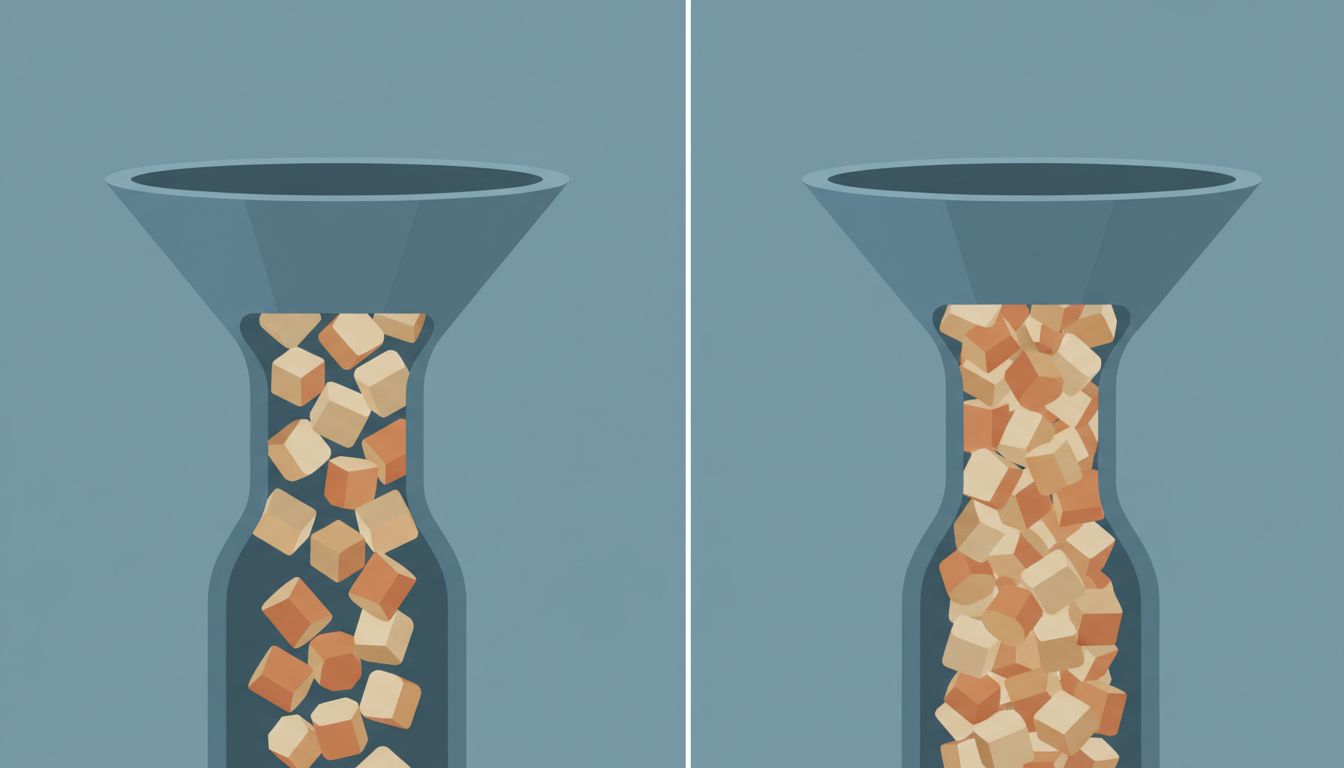
The prefrontal cortex, the region most responsible for executive function, goal-setting, and attention management, has limited parallel processing capacity. It’s serial by design for complex tasks. You can walk and talk simultaneously because walking is largely automated. But you cannot write code and compose an email at the same time, not at full capacity on either. What you’re actually doing is alternating rapidly, paying the switching penalty on every cycle.
The people who seem great at multitasking are usually good at rapid task management, knowing when to pause, save state, and switch cleanly. That’s a different skill entirely, and it’s learnable.
Your Environment Is Designed to Break Your Focus
This is where the blame has to shift. Most knowledge workers operate in environments that are structurally hostile to sustained concentration. Open offices eliminate acoustic privacy. Chat tools default to synchronous norms. Meeting culture fragments calendars into unusable shards. If you need four-hour blocks to do your best work, and your calendar rarely gives you four consecutive hours, the problem isn’t your focus. The problem is the schedule.
Organizations often treat attention as infinitely renewable because it’s invisible. They’d never interrupt a manufacturing line every 15 minutes and call the lost output a personal productivity problem. But they do exactly that with knowledge workers and then recommend mindfulness apps.
The Counterargument
Someone will point out that many high-performers work in interrupt-driven environments and produce excellent results. That’s true. Some work genuinely requires rapid context switching: incident response, customer support, certain management roles. The brain can adapt to high-interruption environments, and some people calibrate well to them.
But the argument isn’t that focus is always possible or that all switching is bad. The argument is that framing focus as a matter of personal willpower misdiagnoses the problem and leads to bad solutions. Meditation and time-blocking are useful tools. They’re not cures for a broken environment. If your team’s meeting culture is fragmenting the calendar, no amount of personal discipline fully compensates.
What You Can Actually Do
Understanding the mechanism gives you better levers. A few worth applying directly:
Reduce incomplete tasks in working memory. Capture everything in a trusted system before switching. The Zeigarnik effect (the brain’s tendency to fixate on incomplete tasks) is real, and externalizing tasks reduces cognitive load.
Design your interruption policy. Decide in advance when you are and aren’t reachable. A 90-minute protected block in the morning is more valuable than a vague intention to “focus more.”
Batch context switches deliberately. If you have to switch between coding and communication tasks, cluster the communication into defined windows. You still pay the switching cost, but you pay it once instead of twenty times.
Respect recovery time. After a meeting or interruption, budget ten minutes to rebuild your task context before expecting deep work. You’ll get there faster if you plan for the ramp than if you pretend you can pick up instantly.
Your brain isn’t broken. Your setup probably is. Fix the setup.