A founder I know spent eight months building a project management tool for architecture firms. Solid product, real pain point, good early feedback. When it came time to price it, he panicked. He looked at what he was offering, thought about all the ways it wasn’t perfect yet, and landed on $29 per month. Safe. Accessible. Reasonable.
He got almost no traction. The few people who signed up churned fast and left vague feedback. When he finally pushed through his discomfort and raised prices to $199 per month, conversions went up. Churn dropped. Customers started sending detailed feature requests instead of disappearing. Nothing about the product changed. Only the number on the pricing page.
This is not a freak outcome. It happens constantly, and founders keep being surprised by it.
Price Is Information, Not Just Cost
Buyers use price as a signal before they use it as a cost calculation. When a professional walks onto a car lot and sees a vehicle priced 40 percent below everything comparable, their first thought is not “great deal.” It’s “what’s wrong with it?”
The same mechanism works in B2B software, professional services, and consumer products. A price point communicates something about what the seller believes the product is worth. If you price low, you are telling the market, before anyone reads a single word of your copy, that you do not believe you have built something particularly valuable. Buyers hear that signal even when they can’t articulate it.
This is why the instinct to “make it easy to say yes” by lowering the price so often produces the opposite result. You think you’re removing friction. You’re actually adding doubt.
The Commitment Problem Cheap Pricing Creates
Low prices don’t just signal low value. They attract buyers who are not committed to using the product.
When someone pays a meaningful amount for a tool, they have skin in the game. They’ll invest the time to set it up properly, train their team, push through the learning curve. They need it to work because they’ve made a real decision. When someone pays almost nothing, they treat it like a free trial with a formality attached. The moment it requires effort, they’re gone. And they’ll churn without telling you why, because they never cared enough to figure out what went wrong.
This is why your cheap-tier customers are often the noisiest and most expensive to support while also delivering the least signal about whether your product actually works. Your first ten customers are already capable of poisoning your roadmap in this way, and artificially cheap pricing accelerates it. You end up optimizing for people who were never the right fit.
The Budget Holder Problem
In B2B, cheap pricing creates a structural problem that’s rarely discussed: you price yourself below the threshold where real decision-makers care.
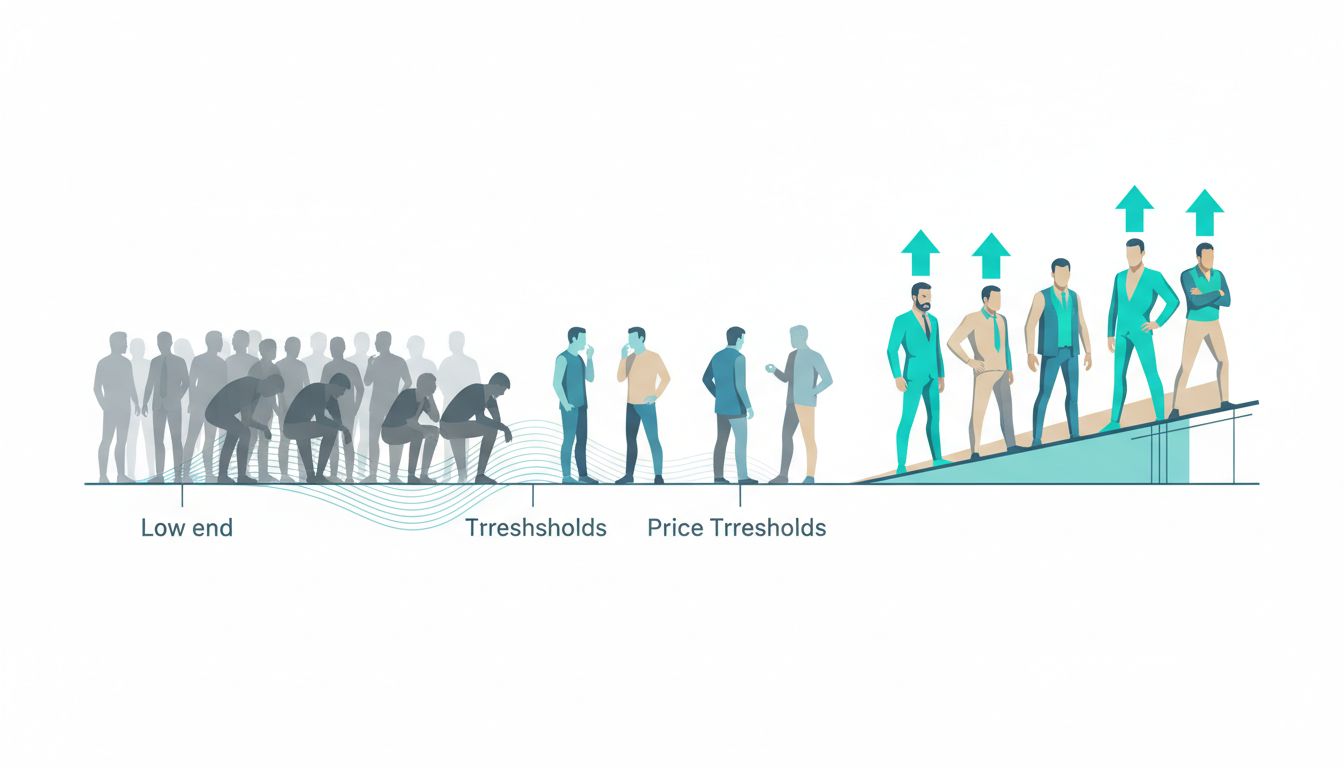
Most organizations have informal tiers for purchase authority. A $30/month subscription might sit on someone’s personal credit card, approved by nobody. A $500/month subscription goes through a team lead. A $2,000/month subscription gets a manager involved. Once you’re past certain thresholds, the right people are paying attention, asking real questions, and, when they approve, actually invested in making the implementation work.
If you price your product so low that it flies under the radar of anyone with organizational authority, you will close deals with people who cannot drive adoption internally. The product sits unused, and you get blamed for it. Price higher, and the person signing off actually champions the rollout. This is why enterprise software companies sometimes raise prices specifically to get into rooms where real decisions happen.
Why Founders Price Too Low (And It’s Not What They Think)
The conventional explanation is that founders are afraid of rejection, so they discount preemptively. That’s partly true. But there’s something more specific going on.
Founders know every flaw in their product. They’ve seen every bug, every missing feature, every case where the UX isn’t quite right. They apply an internal discount based on all the ways the product isn’t finished yet. The customer, who hasn’t seen any of this, evaluates the product on whether it solves their problem. Those are completely different calculations.
When you price based on your internal assessment of incompleteness, you’re charging for the product you think you should have built rather than the product that’s actually in front of someone with a real need. If it solves their problem, it’s worth what it’s worth to them. Their willingness to pay has almost nothing to do with your feelings about your code quality.
The other driver is competition. Founders look at competitors and price below them, assuming this will win on value. Occasionally this is the right move. More often, it just associates you with the low end of the category in a way that’s very hard to escape. Customers who chose you because you were cheaper will leave the moment something even cheaper shows up. There’s no loyalty in a race to the bottom.
The Signals That Tell You Your Price Is Too Low
High churn with vague feedback is the most common one. When customers leave and don’t tell you why, they were usually never that invested to begin with. Price was probably part of it.
Another signal: prospects who don’t push back on price at all. In a normal sales process, some price friction is healthy. It means buyers are taking the decision seriously. When nobody flinches, either you’ve somehow perfectly matched price to value (possible) or you’ve left a lot on the table and attracted people who weren’t really evaluating whether this was the right tool.
You also see it in support quality. Cheap customers tend to generate more support tickets per dollar of revenue and give lower quality feedback. They want hand-holding rather than outcomes. That’s a resource drain that compounds as you scale.
And the most direct signal: when you raise your prices as an experiment and conversion rates hold steady or improve. Founders who’ve never done this are often genuinely shocked. If you raise price 50 percent and nothing bad happens, you were underpriced by at least that much.
How to Actually Find Your Real Price
The Van Westendorp Price Sensitivity Meter, developed in the 1970s by Dutch economist Peter van Westendorp, is the most practically useful framework for this. You ask buyers four questions: at what price would this feel so cheap they’d question the quality? So cheap it’s a bargain? So expensive it’s starting to feel like a stretch? So expensive they’d rule it out entirely? The overlap between “bargain” and “starting to feel like a stretch” gives you your viable range. It’s not magic but it produces real data instead of founder anxiety.
Value-based pricing, where you anchor the price to the outcome you create rather than your costs or competitors, is the other approach that works. If your tool saves an architecture firm 10 hours per project and they run 40 projects a year at billing rates above $150/hour, the math on what your product is worth to them is straightforward. Your price should be some fraction of that value creation, not some multiple of your hosting costs.
Raise prices in increments if the jump feels too large to test all at once. But do it with intention. “We’ll raise it later when the product is more mature” is how founders stay underpriced for years. The product is never finished. The time to find the real price is now.
What This Means
Low pricing feels like a founder being humble and customer-friendly. Usually it’s the opposite. It’s a founder projecting their own anxieties onto a customer who just wants to know if the product solves their problem.
Price is a claim you make about what you’ve built. It tells buyers whether they’re looking at something serious or something provisional. It determines who shows up, how committed they are, and whether the right people in an organization ever pay attention to the decision. As the startup that charges too little almost never recovers shows, the damage compounds over time as you build infrastructure around the wrong customers at the wrong price.
The instinct to make things cheaper to remove friction is understandable. It’s also usually wrong. Find what your product is actually worth to the people who need it most, and charge that.