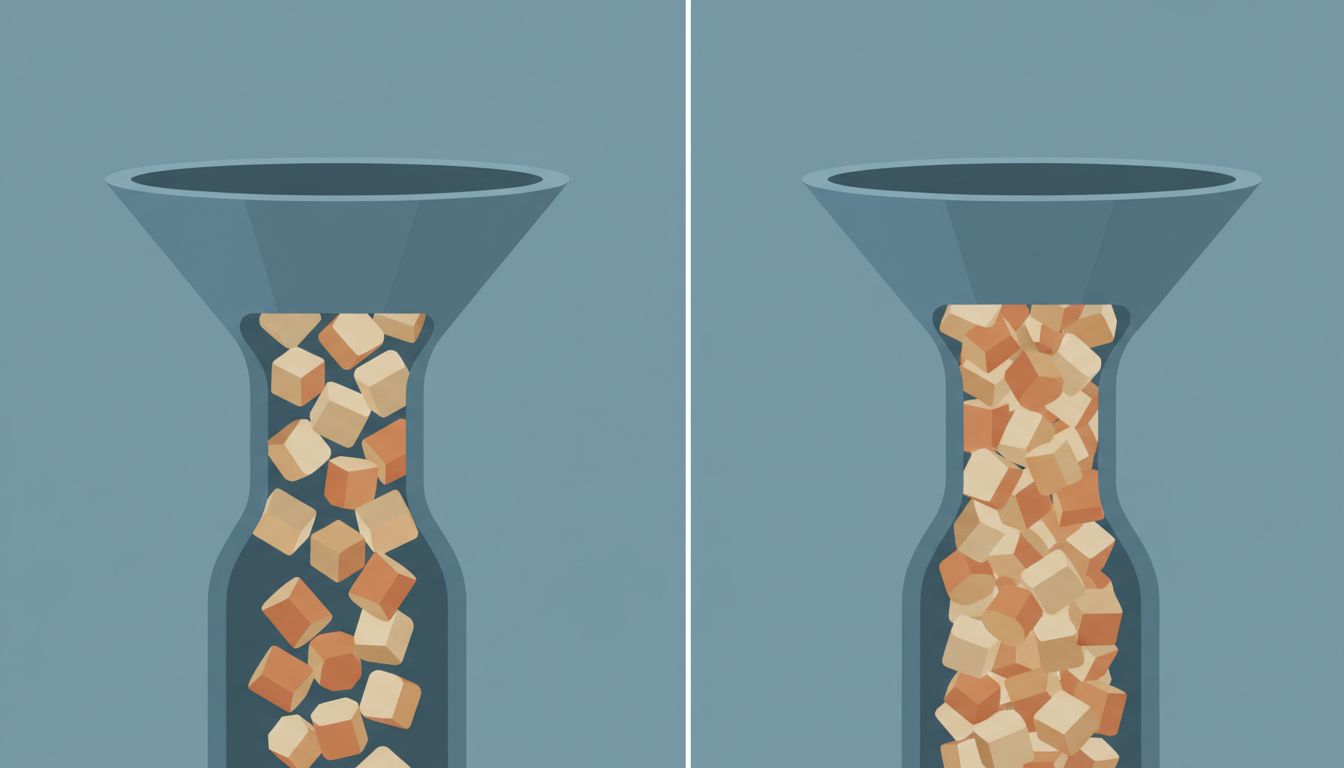

Most knowledge workers have a window of two to four hours each day when their thinking is genuinely sharp. Not productive in a general sense, but deeply, qualitatively better. The kind of thinking where hard problems yield, where the code actually flows, where the writing comes out in sentences rather than fragments. You probably know roughly when yours is. And if you look at your calendar, there’s a good chance you’ve got a recurring standup sitting right in the middle of it.
This isn’t a time management problem. It’s a prioritization error that compounds daily, and most organizations are structuring it in by default.
Cognitive peaks are real and short
Your brain doesn’t run at a flat capacity across the day. Alertness, working memory, and the ability to hold complex state all vary on a circadian rhythm, and the research on this goes back decades. For most people (though not all, morning larks and evening owls are genuinely different), peak cognitive function lands somewhere between late morning and early afternoon. That’s not a long window. It’s also not flexible in the way a meeting slot is.
The reason this matters more for developers, writers, and analysts than it does for, say, a sales call is the cost of context. A meeting interrupts a process. Deep work interrupts a state. If you’re three hours into debugging a subtle concurrency issue and you stop for a thirty-minute sync, you don’t pause at hour three and resume there. You restart. The mental model you’d built up, the hypotheses you were holding in working memory, the thread of reasoning you were following, it dissolves. Researchers who study interruption costs sometimes call this “reimmersion time.” It’s the gap between when you sit back down and when you’re actually back where you were, and it’s longer than people assume.
The scheduling default is optimized for availability, not output
Calendar tools show free/busy status. They don’t show “deep work in progress” or “peak cognitive window.” So when someone needs to find a meeting slot, they look for open space, and open space in the morning looks the same as open space in the afternoon. The result is that meetings fill available gaps without any signal about what those gaps are actually worth.
This is a structural problem, not a personal one. Your manager isn’t malicious for scheduling the 10am architecture review. They just don’t have visibility into the fact that 10am is when you do your best thinking, and the tool they’re using doesn’t give them any reason to ask.
The fix isn’t to decline every meeting. It’s to be deliberate about which hours you protect and explicit about why. Block them on your calendar with a name that communicates intent, not just “busy.” “Deep work: auth refactor” is harder to override than an empty slot, and it signals to your team what they’d be interrupting.
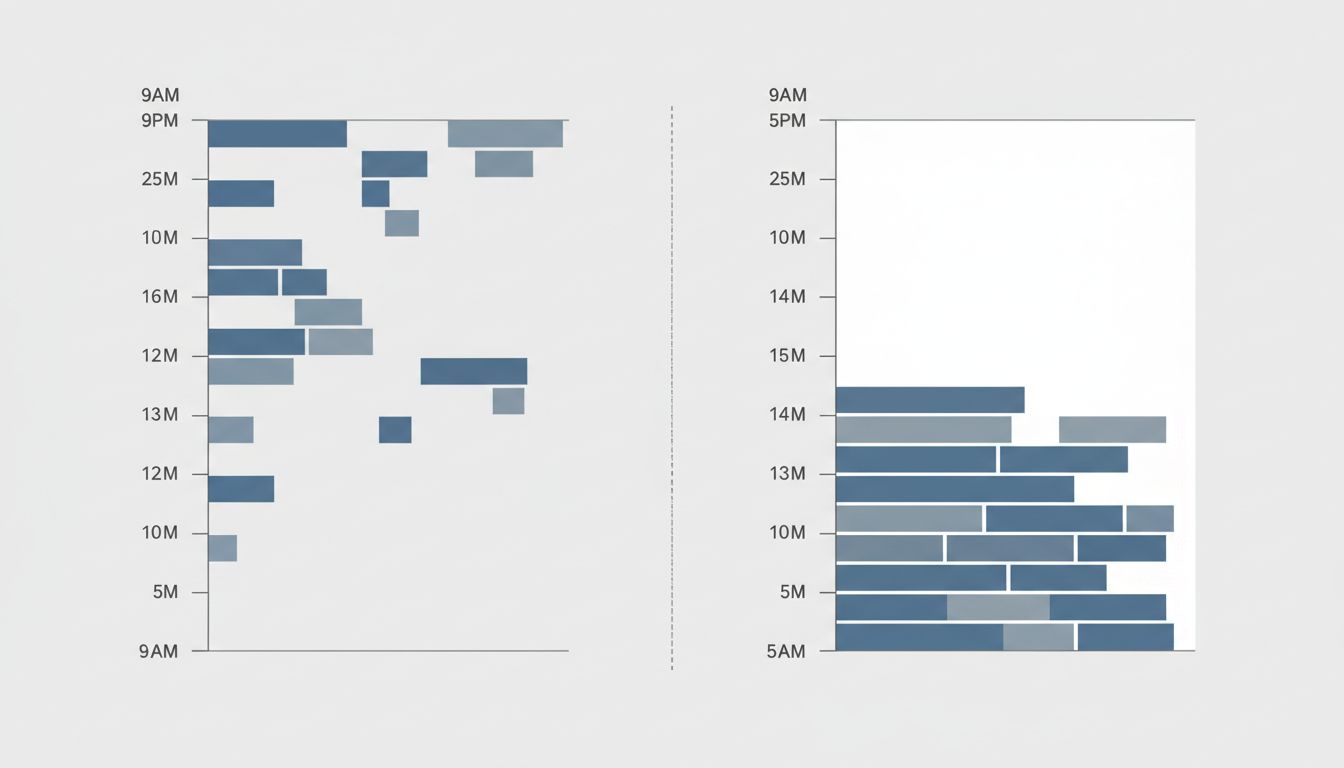
Meetings are not the enemy. Randomly placed meetings are.
There’s a version of this argument that turns into “meetings are bad,” and that’s too blunt. Synchronous communication is genuinely valuable. The problem is placement, not existence.
A meeting at 4pm costs very little in terms of displaced deep work, because most people aren’t doing their sharpest thinking at 4pm anyway. That same meeting at 9:30am, right as you’re getting into flow, costs an afternoon’s worth of output in exchange for thirty minutes of alignment. The math is bad even if the meeting itself was useful.
The implication is that teams should think about meeting scheduling the way good systems architects think about resource contention. You wouldn’t run your most expensive database queries during your peak traffic window without a reason. You’d batch them, defer them, or find a cheaper time to run them. The same logic applies to synchronous communication. Not all hours are equivalent, so not all meeting times are equivalent.
The counterargument
The reasonable pushback here is that collaborative work also requires cognitive quality, and you can’t just push everyone’s meetings to the afternoon when some people are sharpest in the afternoon. Coordination costs are real. If everyone independently optimizes their calendar for personal peak performance, the resulting scheduling puzzle becomes unsolvable.
This is fair. Team coordination is a real constraint, and I’m not arguing for unilateral calendar hermitage. The point is narrower: most teams haven’t had the explicit conversation about which hours matter most for which kinds of work. They’re defaulting to whatever the calendar app makes easy. A team that has actively agreed on meeting norms, that has said “we protect mornings for focused work and cluster syncs in the early afternoon,” is in a fundamentally different position than a team that just books meetings wherever there’s space.
That conversation is almost never happening. It should be.
What to actually do
Identify your peak window honestly. Not when you should be productive, but when you actually do your best work. Block it on your calendar with a descriptive name. Communicate to your team what you’re doing and why, and propose a norm rather than a personal exception. Suggest that the team cluster recurring syncs in one part of the day and treat another part as protected time.
You probably won’t recover all of it. But recovering even an hour a day of uninterrupted peak-hour work compounds significantly over a week, a quarter, a year. The hours exist. They’re just getting scheduled over.