I once watched a founder celebrate crossing $50K MRR. The team had a party. The investors sent champagne. Three months later the company was in crisis talks, because at their price point, $50K MRR required a customer count that made support costs alone unprofitable. They weren’t almost there. They were digging faster.
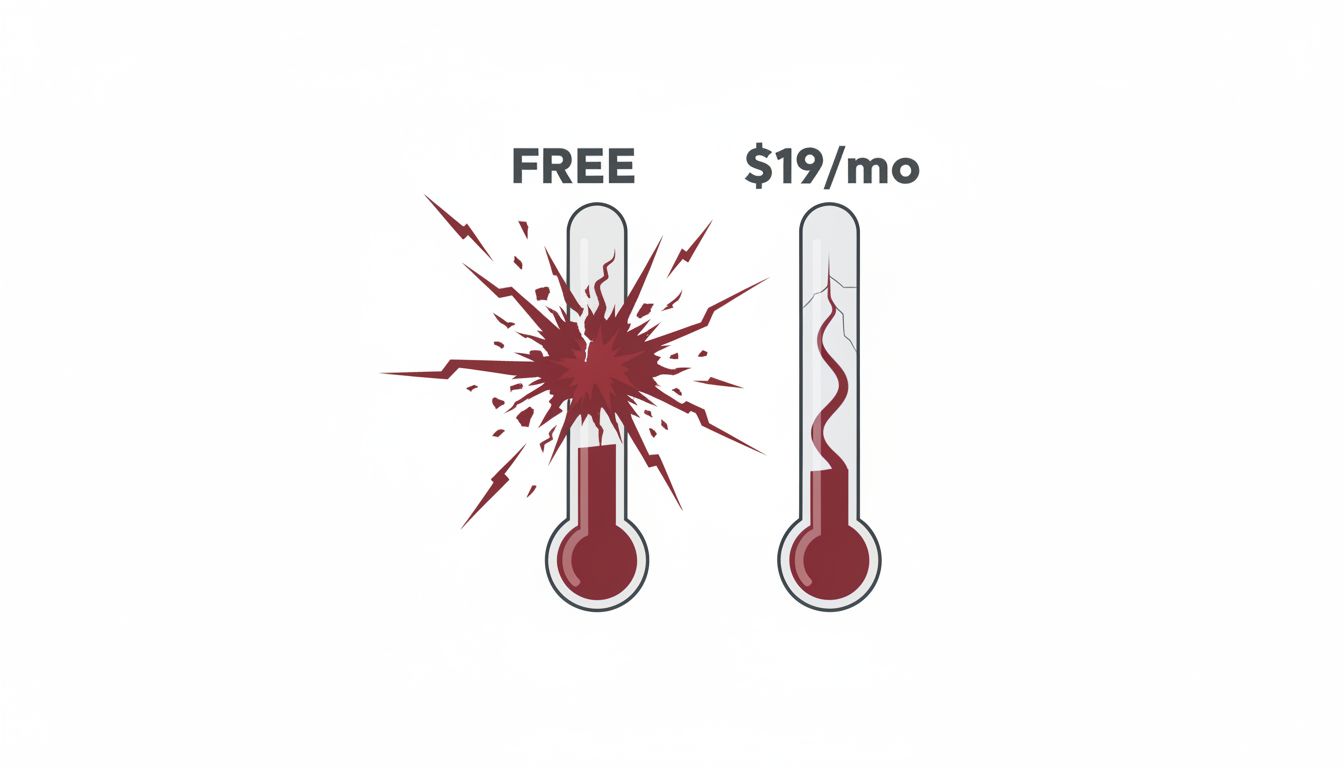
Free is obviously fatal. Founders know this, at least intellectually. But underpricing is where most startups actually die, and they die slowly enough that the cause of death gets misattributed. By the time the autopsy happens, everyone blames the product or the market or the timing. Nobody says “we charged $29 a month when we should have charged $199.”
I’m arguing that the startup charging too little is in more danger than the one charging nothing, and the reason is almost entirely about what cheap pricing does to your head.
Free at Least Forces a Reckoning
A company charging nothing knows it has a business model problem. That clarity is brutal but useful. It has to either find monetization or shut down. The timeline is short, the feedback is loud, and the decisions are forced.
The company charging $19 a month for something that costs $23 a month to support has no such clarity. Revenue is real. Customers are real. Growth feels real. Every metric looks like progress until suddenly the unit economics land on someone’s spreadsheet and the whole thing collapses at the moment it should be scaling. The problem isn’t that they failed. It’s that they spent three years failing in slow motion while thinking they were succeeding.
This is the trap. Underpricing creates just enough signal to keep going and not enough margin to go anywhere.
Low Prices Attract the Wrong Customers
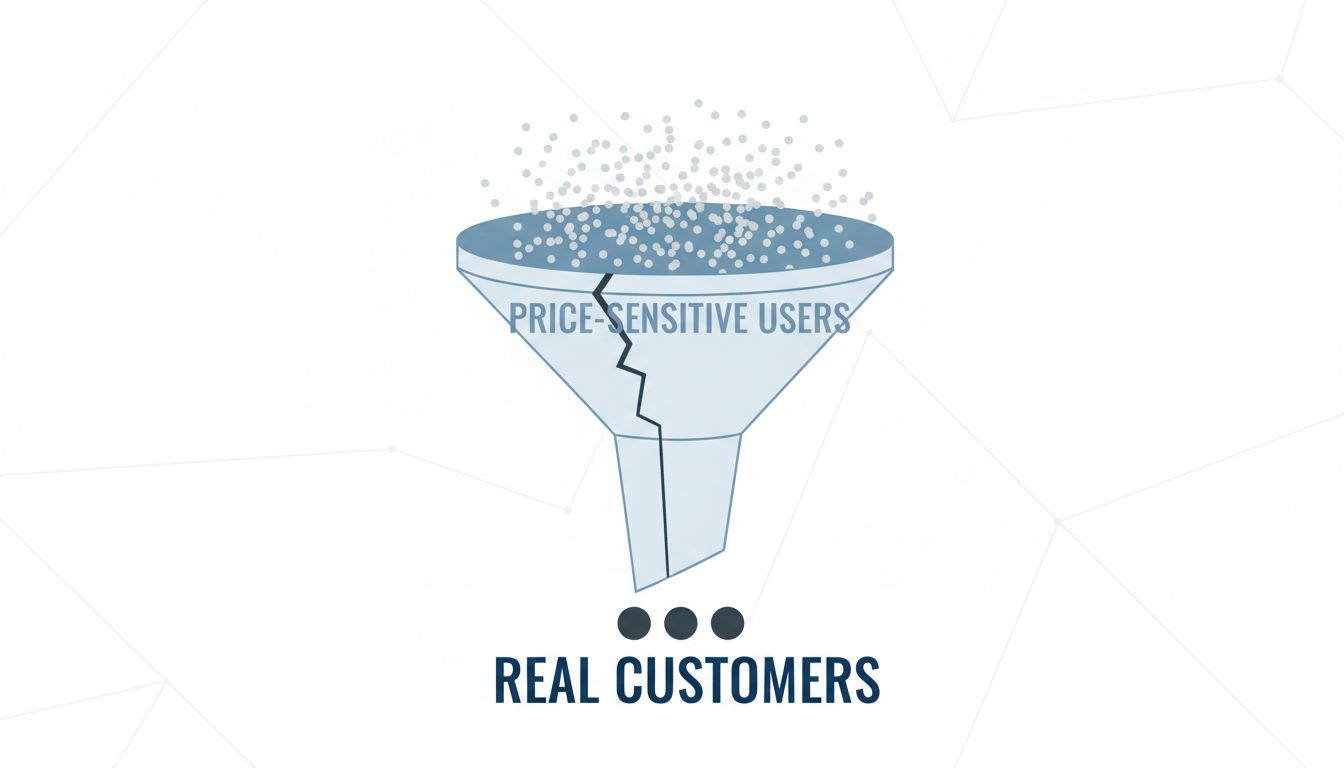
Price is not just a revenue mechanism. It’s a filtering mechanism. When you charge $15 a month, you get customers who make decisions at $15 a month. They churn at friction. They complain about things that cost you hours to address. They resist upsells. They don’t refer high-value users because they don’t know any.
The customers you actually want, the ones who stick around for years, who expand their usage, who give you real product feedback, those customers are not optimizing for the cheapest option. They’re looking for something that solves a serious problem. Price signals seriousness. A $500 monthly contract says “this is a real tool for a real budget line.” A $19 charge says “this is something I’ll cancel when I get distracted.”
The startup that ignored its best customers won makes a related point about who you’re actually building for. Low pricing doesn’t just cost you margin. It actively recruits the customers who will cost you the most while teaching you the least.
You Can’t Invest in Quality If You’re Subsidizing Usage
Support, infrastructure, product development, competitive hiring, sales. All of it costs money. When your pricing doesn’t support those costs, you start making small compromises. You delay the hire. You skip the refactor. You don’t build the integration your best customers are asking for. Each decision seems defensible in isolation and catastrophic in aggregate.
This is why the slow death is so much worse than the fast one. You spend years in a condition where you can’t quite afford to get better. You’re not in crisis, so you don’t take crisis-level action. You’re not profitable, so you can’t invest aggressively. You’re stuck in the middle, hoping something changes, and the thing that would change it (raising prices) feels too risky because you’ve now built a customer base that chose you specifically because you were cheap.
The Counterargument
The obvious objection is that low pricing is a deliberate wedge strategy. Get in cheap, acquire users, raise prices later. This works, occasionally, when the product creates switching costs fast enough that customers can’t easily leave when prices go up. Slack is the example everyone reaches for.
But Slack was not actually cheap. Even its free tier was engineered as a sales tool with hard limits that pushed teams toward paid plans. The pricing was a funnel, not a subsidy. Most founders who invoke this argument are not running Slack. They’re running something with no switching costs, a customer base that will churn the moment prices move, and a vague hope that growth will solve the math. It won’t.
Charging before you build is the smartest startup move because it forces the pricing conversation before you’ve built assumptions about value into your product and your customer relationships. Once you’re three years in with 2,000 customers who pay $19 a month, raising prices becomes an existential event.
The Right Time to Fix Pricing Is Now
If you’re underpriced, you already know it. You feel it in the support queue, the churn conversations, the investors who keep asking about unit economics. The question isn’t whether to fix it. It’s whether you’ll fix it while you still have runway to manage the fallout.
Some customers will leave when you raise prices. Good. The customers who leave were the ones costing you the most and teaching you the least. The ones who stay are the foundation of an actual business.
The startup that charges nothing gets a fast, legible failure. The startup that charges too little gets years of ambiguous struggle followed by the same failure, just later, and with more scar tissue. Charge what the problem is worth. If you don’t know what that is, charge more than you’re charging now and see what happens.
Most of what happens will surprise you.