

The simple version
Every meeting you attend has a hidden cost beyond the time it occupies. The meeting you canceled returned that cost to everyone involved, and that return compounds in ways most people never account for.
The unit of work isn’t the hour, it’s the block
Knowledge workers don’t produce in hourly increments. They produce in uninterrupted stretches. Cal Newport calls this “deep work,” but you don’t need a term for it to recognize the phenomenon: the first 20 minutes of focused work on a hard problem are mostly warm-up. You’re loading context into working memory, the same way an operating system loads a program’s state before it can run. If you get interrupted before you’ve hit your stride, that load cost is wasted entirely.
A two-hour block of uninterrupted time is not twice as valuable as two one-hour blocks. For complex problems, it can be five or ten times as valuable. This isn’t a metaphor. Cognitive science research on “attention residue” (a term from researcher Sophie Leroy) shows that when people switch tasks, part of their attention stays anchored to the previous task, degrading performance on whatever comes next.
A meeting planted at 2pm doesn’t just consume the hour from 2 to 3. It fractures the afternoon into two smaller pieces, neither of which may be large enough to do real work. The meeting at 2pm is also costing you the 90 minutes before it, because you know it’s coming.
Canceling isn’t avoidance, it’s allocation
There’s a reason people feel vaguely guilty when they cancel a meeting, even a useless one. Meetings signal participation. They are socially legible in a way that independent work isn’t. “I was in meetings all day” reads as busy. “I blocked my calendar and worked alone” sounds like you might be avoiding something.
This is a measurement problem masquerading as a productivity problem. Organizations have always had an easier time counting meetings than counting the quality of thinking that happens between them. Most meetings shouldn’t have been scheduled at all, but the ones that do get scheduled have a powerful social gravity. Canceling one requires overriding that gravity, which takes deliberate effort.
The useful reframe is to think of canceling a meeting as a budget decision, not an avoidance decision. You’re reallocating that time from a scheduled, defined activity to an open, flexible one. Open time feels less productive because it’s harder to describe afterward. It rarely is less productive, especially for technical or creative work.
The compound effect nobody tracks
Here’s where it gets counterintuitive. The value of a canceled meeting isn’t just the time it returns. It’s what that time enables.
Imagine a small engineering team with a standing 30-minute sync every day at 10am. That’s 2.5 hours per week per person. For a team of six, it’s 15 person-hours weekly. That number is visible and people argue about it when the meeting comes up for review.
What’s invisible: that daily 10am sync prevents any morning block from extending past two hours. For engineers who tend to arrive early and do their best work from 8 to noon, this is catastrophic. The meeting isn’t just taking 30 minutes. It’s acting as a ceiling on every morning’s potential focus period.
Cancel that meeting, and you haven’t just returned 15 person-hours per week. You’ve potentially unlocked a different shape of workday for everyone on the team, one where mornings can run long when a problem demands it. The value of that change doesn’t show up in any calendar analytics tool.
The meeting that didn’t happen still communicates
A reasonable objection: some meetings do real work. Status alignment, unblocking dependencies, surfacing information that’s stuck in someone’s head. If you cancel those, the work doesn’t disappear, it just moves somewhere else, usually to a slower, more frustrating channel.
This is true, and it’s the right objection. The answer isn’t to cancel everything. It’s to be precise about what a specific meeting is actually doing.
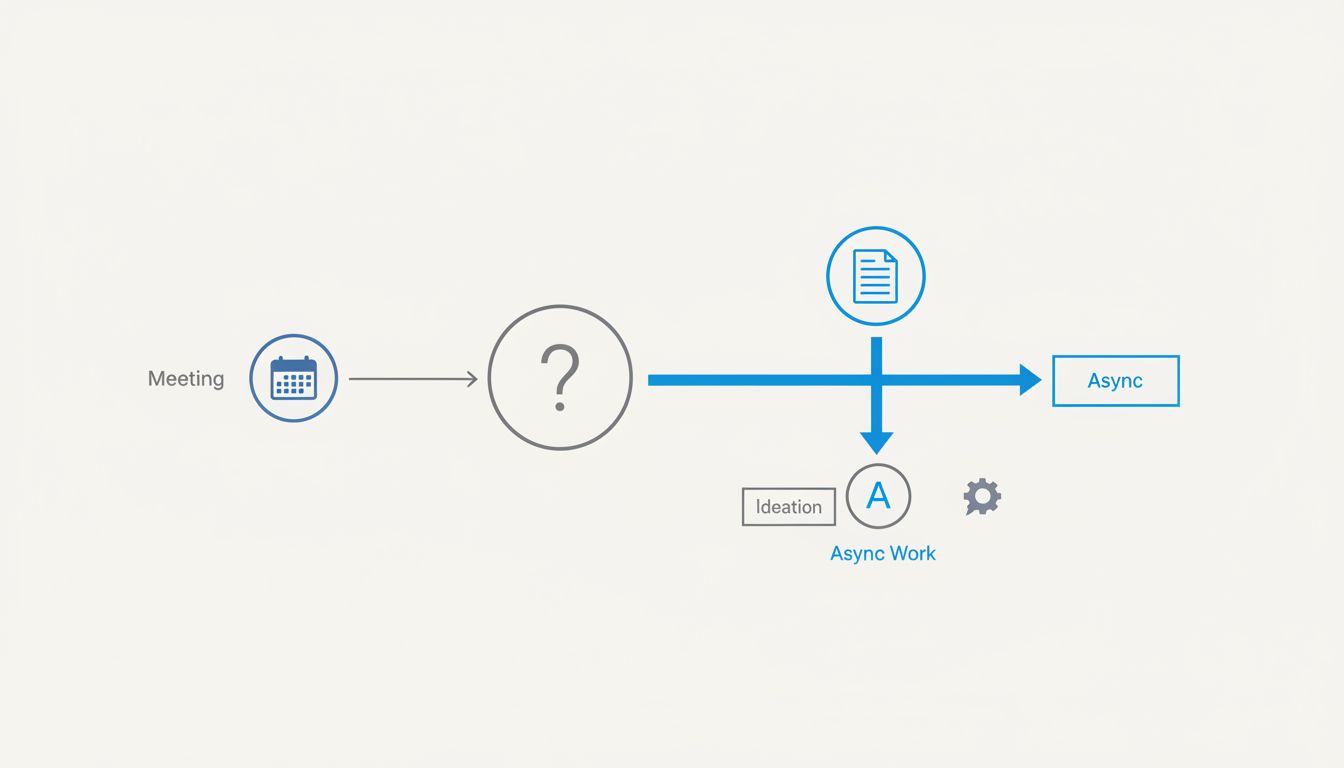
A meeting that exists to share information is almost always replaceable by a written update. A meeting that exists to make a decision can often be replaced by a clear proposal sent in advance with a 48-hour response window. Both of these alternatives force the organizer to clarify their thinking before the meeting happens, which is useful work that a scheduled meeting tends to defer.
A meeting that exists to solve a problem that two or three specific people need to work through together is often worth having, but it should probably be smaller and shorter than it currently is. The invisible meeting is draining your day in part because every recurring sync gradually accumulates attendees who don’t strictly need to be there, expanding scope and shrinking the space for actual problem-solving.
The asymmetry you should build around
The practical upshot is this: before you schedule a meeting, the burden of proof should be on the meeting. Not in a hostile way, but in the same way a good engineer asks “do we actually need this dependency?” before adding it to a project. Dependencies compound. So do meetings.
Ask what the meeting produces that can’t be produced asynchronously. If the answer is “a shared understanding that’s hard to build in text,” that’s a real meeting. If the answer is “we need to make a decision,” try the async route first. Most decisions that feel urgent enough to require a meeting are not actually urgent.
The meeting you canceled didn’t just give everyone their hour back. It gave everyone the option to use that hour as part of something larger. That option is almost always worth more than the meeting itself.